

 Ravi Dangariya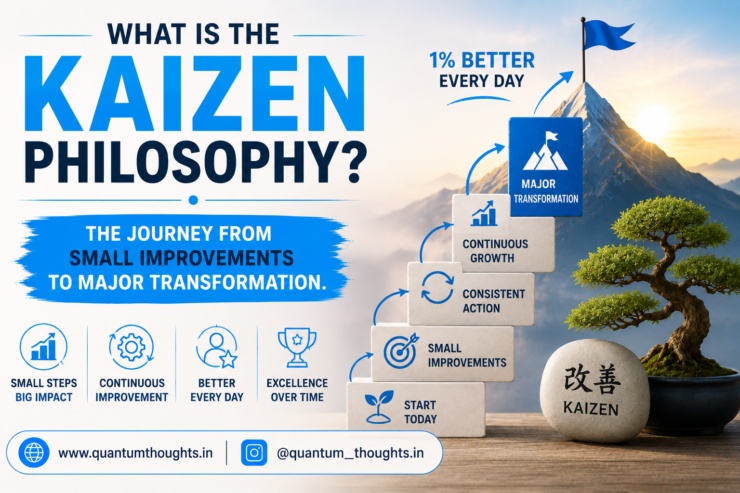
“Great transformations rarely begin with giant steps. They begin with small improvements repeated every day.”
Many people consider making major decisions to change their lives.
“I will study for three hours every day starting next Monday.”
“I will go to the gym daily starting next month.”
“I will change all my bad habits in a single day.”
However, this enthusiasm often fades after just a few days.
This is because bringing about major changes all at once is difficult.
This is where the Kaizen philosophy offers a different perspective.
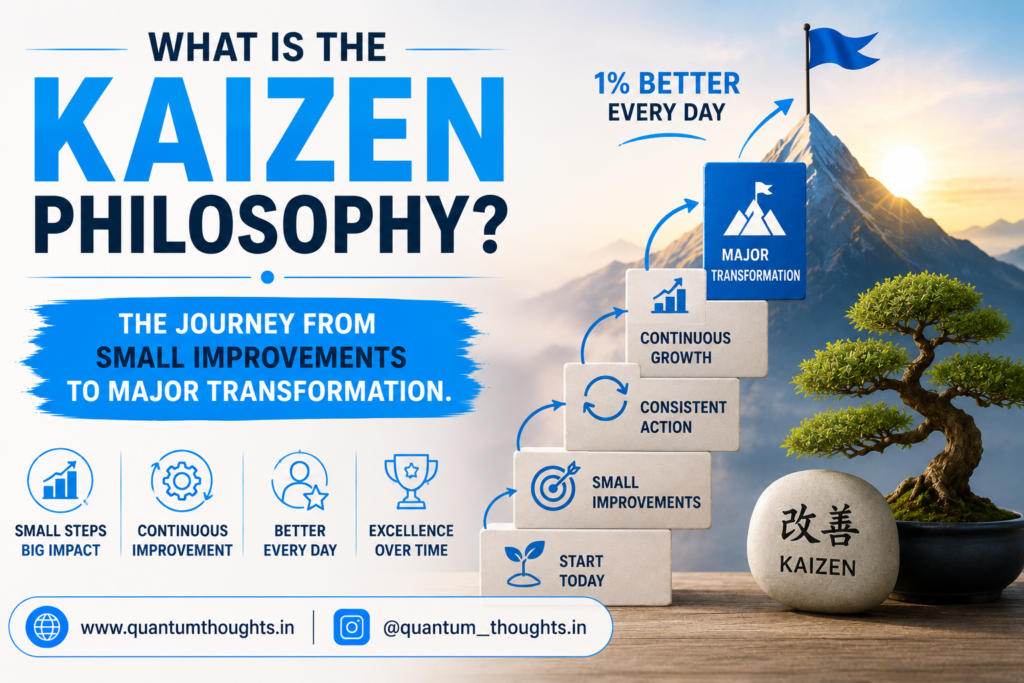
This means you don’t have to take massive steps to make a significant difference. Little improvements everyday add up to the biggest change over the long run.
What is Kaizen ?
Kaizen is a Japanese term.
It consists of two words:
Kai = Change
Better= Zen
So Kaizen means:
Continuous Improvements.”
This philosophy became popular with many Japanese companies after World War II. This approach – making improvements in quality and efficiency in small, incremental steps – has been very successful, particularly in manufacturing.
Eventually Kaizen moved outside the industrial sector. It is being used in their studies, business, health, relationships and personal development also today.
The Core Idea of Kaizen
The fundamental principle of Kaizen is very simple.
Make small improvements every day.
Do not try to change your life in a single day.
Do just a few percent better today than you did yesterday.
Over time, these small improvements transform into significant results.
A simple example
Suppose a student decides to study for 3 hours every day.
He succeeds for the first two days.
On the third day, he gets tired.
And within a few days, the entire plan is abandoned.
Another student starts by studying for just 20 minutes.
He maintains this habit every day.
After a few weeks, he gradually increases the time.
By the end of the year, the second student is more likely to have made consistent progress.
This is the essence of Kaizen.
Why do small steps work?
Psychology tells us that big changes can be scary.
The brain is often averse to big sudden changes.
Still, little changes seem manageable.
This makes it more likely that you’ll hold onto them long-term.
Habits are formed gradually.
And Kaizen employs this very process.
How can Kaizen be applied in life?
Kaizen is not limited to just one area.
You can adopt it in almost every aspect of life.
For reading:
Read just 10 pages a day.
For write:
Daily writing: 200 words.
For practice:
Begin walking 10 minutes a day.
For Meditation :
Spend 5 minutes a day in quiet.
It’s easier to be consistent when you start small.
Kaizen and Perfectionism
A lot of people wait for the perfect before they start a task.
“I will start when I have enough time.”
“I will start once all the preparations are complete.”
But Kaizen says:
Progress is more important than perfection.
A little bit regular is better than a big rare.
Kaizen and Habits
Habits determine our future.
“If you get 1% better every day, it really adds up in a year.”
This does not mean that every day has to be extraordinary.
What matters is that you do not come to a complete standstill.
Consistency is often more important than speed.
Does Kaizen always mean moving slowly?
No.
Kaizen does not mean being slow.
It means steady and continuous progress.
Sometimes, major decisions are also necessary.
But long-term change is mostly built through small, daily habits.
Some Simple Rules of Kaizen
If you wish to adopt the Kaizen philosophy, keep these points in mind:
- Make a small improvement every day.
- Don’t try to change everything at once.
- Just keep it consistent.
- Compare yourself to who you were yesterday.
- Celebrate small victories.
These simple rules can yield significant results over time.
A Limitation of Kaizen
Kaizen is a very useful philosophy, but small improvements alone are not sufficient in every situation.
In certain circumstances, major and rapid decisions may also be necessary.
Therefore, it is not appropriate to consider Kaizen the sole solution for every problem.
This is a good approach for long-term development, but other approaches may be needed depending on the circumstances.









Add comment