

 Ravi Dangariya
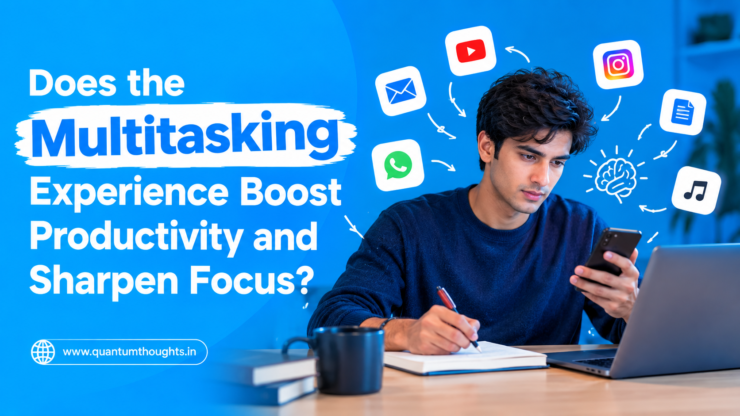
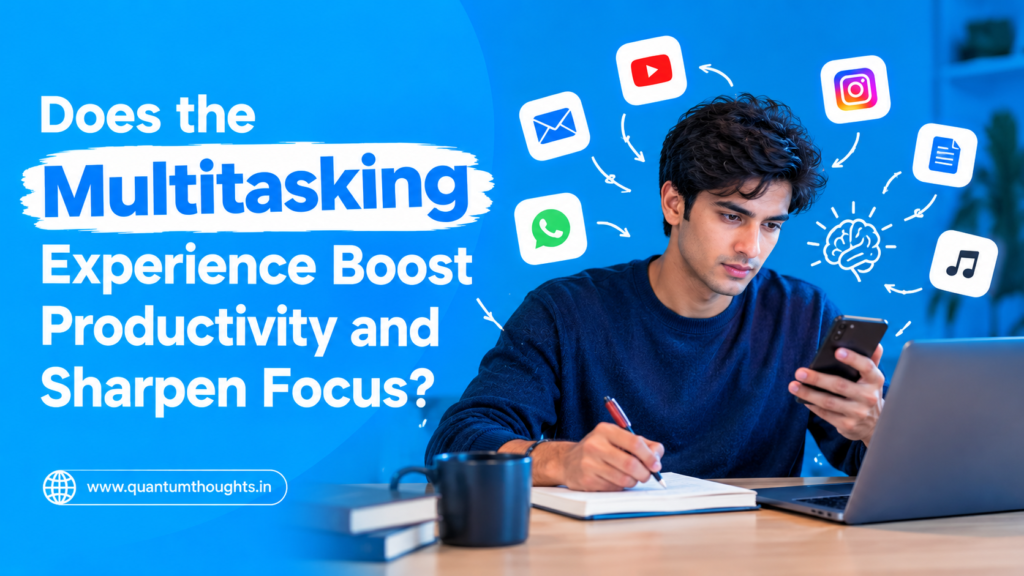
We often believe that being able to do multiple tasks at once makes us more productive.
We are working on a laptop.
We reply to WhatsApp messages simultaneously.
We check Instagram notifications in between.
Then, we open our emails.
And all the while, a YouTube video might be playing in the background.
While doing all this, we feel-
“Look at how much I am managing at once!”
But here is an interesting question:
Does multitasking actually make us more productive, or does it merely create the illusion of productivity?
Psychologically and attentively, multitasking generally reduces focus and increases distraction rather than making us more productive.
So what is multitasking?
In general, multitasking is seen as doing more than one task at a time.
But our brain does not process every task simultaneously, at the same moment.
Many times, we very quickly shift our attention from one thing to another.
For example you are writing an important email and you get a Whatsapp message.
You read the message.
Then, you return to the email.
A short while later, a notification appears.
Your attention shifts there again.
So, you are not actually doing both tasks at the same time.
You are repeatedly switching your attention.
Why does multitasking feel productive?
So, why do we feel like we are getting more done?
Because, to us, activity and progress often seem like the same thing.
When we juggle multiple tasks at once, we are constantly doing something.
Replying to a message.
An email.
A document.
A notification.
This constant activity makes us feel like we are getting things done.
But busy and productive are not the same thing.
Productivity isn’t about how many things you’ve touched, but how much meaningful work you’ve done.
The Cost of Diverting Your Attention
The brain needs to adapt to a new context when switching from one task to another.
Suppose you are writing an article.
Then, a phone notification arrives.
You check the notification.
Then, you return to the article.
You have to recall what you were writing and what needed to be written next.
It might look like a trivial disturbance.
But if these interruptions are frequent throughout the day, they can seriously affect your attention.
It may feel like you are working, but your deep focus is repeatedly being broken.
Why is multitasking difficult for “Deep Work”?
Some tasks require deep concentration.
Such as-
Writing.
Studying.
Programming.
Research.
Reading.
Complex problem-solving.
In such tasks, the brain needs to remain focused on a single problem or idea continuously for a period of time.
If attention shifts elsewhere every few minutes, the mental continuity required for deep thinking can be broken.
That is why, sometimes, even after touching upon many things within an hour, we feel, “I haven’t actually completed anything.”
Notifications can make multitasking worse.
In today’s digital world, notifications are often a major driver of multitasking.
Messages.
Emails.
Instagram.
WhatsApp.
News.
App alerts.
Every notification demands our attention.
Sometimes the notification itself can spark curiosity even when we don’t open it:
“Who sent that message?
And when our minds wander to the phone it’s hard to get back to what we’re supposed to be doing.
That is why, to preserve focus, simply saying “I won’t multitask” isn’t enough.
Sometimes, we need to change our environment as well.
Multitasking and Brain Fatigue
Frequent task switching can lead to mental fatigue.
At the end of the day, you might feel that although you were busy all day, your mind is completely exhausted.
One reason is that your brain has to switch between different kinds of information during the day.
One job.
Another job.
Take note.
Message.
Email.
Back to work.
Back to the phone.
This continuous switching can fragment our attention.
Is all multitasking bad?
No.
Not all multitasking is created equal.
Some things are easy to do together.
For instance, you can listen to basic audio while walking.
But performance is more likely to be affected when the two tasks are competing for your attention and cognitive processing.
So the question is not just:
“Am I doing too many things?”
The more important question is:
“How much focused attention do these two tasks require?”
Why can single-tasking be useful?
Single-tasking means attempting to focus on only one task at a time.
If you are writing an article, then focus solely on writing for that duration.
If you are reading, then focus only on reading.
If you are having an important conversation, put your phone away.
This prevents your attention from constantly switching back and forth.
It may seem difficult at first.
This is because our brains have evolved to constant stimulus.
But with practice one can develop the ability to focus on a single task for an extended period.
How do we cut down on multitasking?
Take a few simple steps:
- Concentrate on one main task at a time.
- Discover the most important things you need to do today.
- Disable unneeded notifications.
- Not every notification needs to be responded to.
- Keep your phone at a distance.
If the phone is right in front of your eyes, your attention may frequently drift towards it. - Create short focus sessions.
Work on a single task for 20–30 minutes, then take a short break. - Remember the difference between being “busy” and being “productive.”
Completing the right task is more important than simply starting many tasks.
Sometimes doing more things at once doesn’t mean getting more done. Sometimes focus is the fastest way to make meaningful progress.
💭 Do share your thoughts in the comments:
After reading this article, what aspect of multitasking did you find most relatable? Share your experience in the comments.
In your opinion, does multitasking actually boost productivity, or does it merely give us the feeling of being busy?
Written by Ravi Dangariya(Rick Patel)










Add comment