

 Ravi Dangariya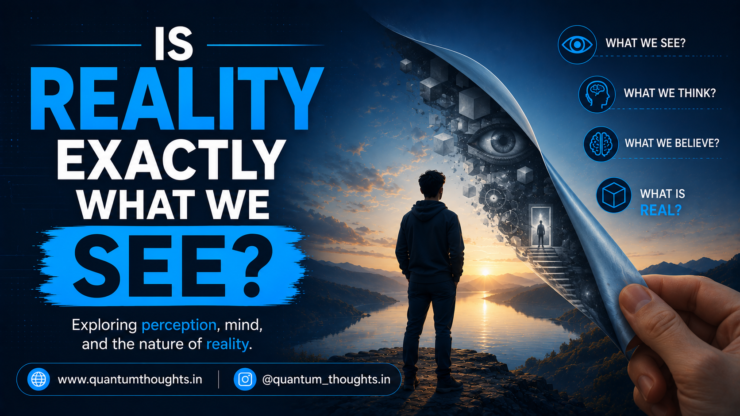
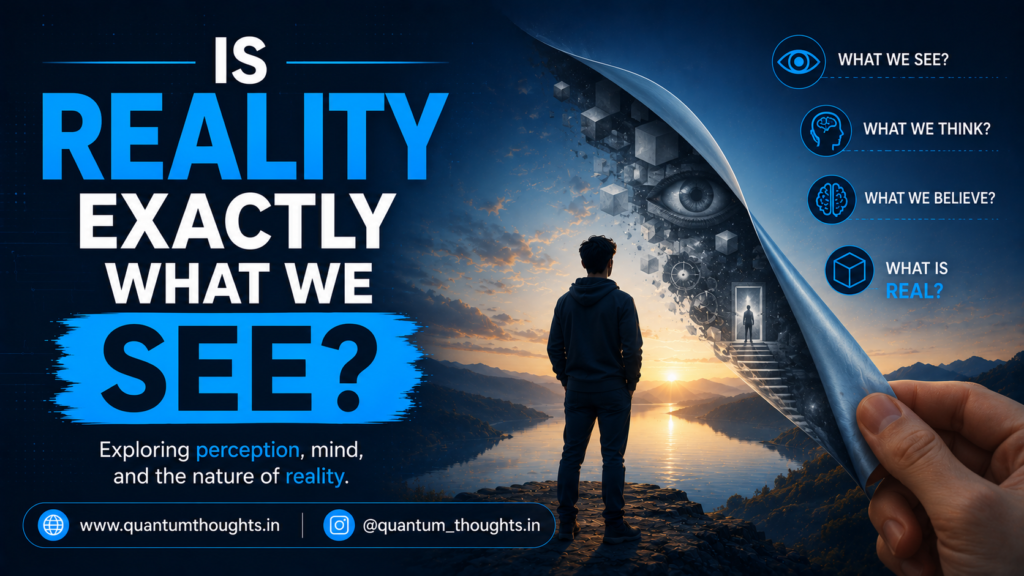
Reality is not always limited by what the eyes can see; sometimes it begins where perception ends.
We consider the world we see every day to be “reality.” The sun rises, the sky appears blue, objects seem stationary, and time is felt moving forward. But is everything truly as it appears to us?
If our senses provide us with information about the world, is that information complete and accurate?
Philosophers, scientists and psychologists have debated this question for thousands of years. And even today scientists and philosophers are trying to understand what is reality and how far we can understand it.
Can we know the world directly?
The answer appears to be “yes” on its face.
But the truth is that we do not see the world directly.
Our eyes merely capture light. The brain then analyzes this information to create an “image.”
Therefore, what we see is not a direct copy of the outside world, but an interpretation created by the brain.
Consequently, two people can experience the same event differently.
Our senses are limited.
We feel that we can see everything.
But science says that is not the case.
For example:
- We cannot see ultraviolet or infrared light.
- We also cannot see radio waves or X-rays.
- Some animals can perceive things that are invisible to humans.
So, just because it’s invisible to us doesn’t mean it doesn’t exist.
We only see a tiny fraction of the universe.
The brain makes reality.
The brain is constantly making predictions.
It seeks to complete a picture from incomplete information.
We fall for optical illusions sometimes that’s why.
A still picture appears to be moving.
A straight line appears to be curved.
Same color, different appearance.
If our eyes always told the absolute truth, these illusions would not be possible.
This shows that we do not see with our eyes only, we see with our brain.
Are we all living in our own personal realities?
This is a somewhat complicated question.
The physical world is universal.
However, the experience of it can differ for each person.
The same rain brings joy to one person.
To another, it brings inconvenience.
The same event inspires one person.
It might cause grief to someone else.
So the event is the same, but each person derives a different meaning from it.
Science and the Real World
Science says that we have to put our ideas about reality to the test of evidence.
Things are not always as they appear.
For example, it appears to us that the sun goes round the earth.
(But actually the earth goes round the sun.)
This shows that we cannot find out the truth by looking at appearances only.
So science is about observation, experimentation and evidence.
What does psych say?
According to psychology, our experiences are influenced by our thoughts, beliefs, and past experiences.
If a person lives in constant fear, even an ordinary situation may seem dangerous to them.
An optimist, however, might see a new opportunity in that same situation.
Thus, we often view the world not as it is, but rather through the lens of our state of mind.
What does psychology say?
According to psychology, our experiences are influenced by our thoughts, beliefs, and past experiences.
If a person lives in constant fear, even an ordinary situation may seem dangerous to them.
An optimist, however, might see a new opportunity in that same situation.
Thus, we often view the world not as it is, but rather through the lens of our state of mind.






Add comment