

 Ravi Dangariya


Familiarity may feel safe, but growth often begins beyond what we already know.
New things attract us, but why do we revert to old habits when the time comes to make a change?
Have you ever decided that you want to do something new in your life?
Perhaps you want to start a new habit, reduce your phone usage, read regularly, or break an old habit.
Initially, there is a lot of enthusiasm.
But after a few days, we slip back into our old routine.
Why does this happen?
Does our brain dislike change?
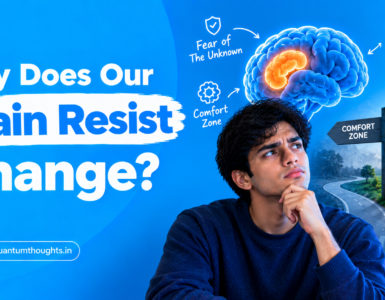
Psychology explains that our brain often prefers things that are familiar. Even if something new might be better for us, the old, familiar option can still feel more comfortable.
Familiarity: Why do familiar things feel safe?
Our brains find it easier to process familiar situations.
We know what might happen there and how to react.
However, new situations involve uncertainty.
Suppose you receive a new job opportunity.
It offers a higher salary, better prospects, and the chance to learn new skills.
Yet, a question arises in your mind:
“What if I don’t succeed there?”
“What if the environment there isn’t good?”
“What if the environment there isn’t good?”
“At least here, everything is familiar.”
In such a situation, the old job feels safer—not because it is the best, but because it is familiar.
Sometimes, we do not choose what is actually better; instead, we choose what we are already familiar with.
Brain Efficiency: Why does the brain prefer old habits?
Our brain develops habits to carry out various processes with minimal effort.
When we perform a task repeatedly, it gradually becomes a part of our daily routine.
For example, checking one’s phone immediately upon waking up in the morning.
Initially, we pick up the phone consciously.
But after a while, checking the phone becomes a habit.
This is known as ‘habit formation.’
Thanks to habits, we do not have to make a fresh decision every single time.
However, the problem arises when an old habit persists, even though it is harmful to us.
We know that excessive phone use wastes time, yet we find it difficult to give it up.
Since a particular behavior may have been part of our daily routine for a long time, changing it might require a conscious effort.
Uncertainty: Why do we fear the unknown?
A question is always attached to change.
“What will happen next?”
We crave certainty regarding the outcome.
However, the outcome of every change in life cannot be known in advance.
Suppose you want to start a new business.
You are interested in it, but the fear of failure also lingers in your mind.
“What if I lose my money?”
“What if people make fun of me?”
These thoughts can prevent you from getting started.
The issue here is not just the possibility of failure.
The problem is also that we find it difficult to tolerate uncertainty.
However, uncertainty does not always mean risk. Sometimes, it is the beginning of new possibilities.
Loss Aversion: Why Do We Fear Loss?
In psychology, “loss aversion” refers to the tendency to avoid losses.
In many situations, we focus more on the possibility of losing something than on the possibility of gaining something.
For example, suppose you want to learn a new skill.
However, you realize that it will take time and that you won’t be very good at it initially.
You start thinking:
“Instead of wasting all this time, it’s better to just stick with what I’m already doing.”
In this way, we may end up focusing more on the fear of losing our current situation than on the benefits offered by a new opportunity.
But there is a question worth considering.
Are we truly avoiding a wrong choice, or are we merely avoiding the discomfort of change?
There is a difference between the two.
Identity: Do old habits become our identity?
Sometimes, we come to view our habits as our identity.
“This is just who I am.”
“I am unable to maintain consistency.”
“I cannot speak in front of people.”
Such thoughts can keep us from changing.
This is because the issue is no longer just about a habit.
We begin to believe that change is beyond our capability.
However, it is important to remember one thing.
Your current habits are not your permanent identity.
If you do not read regularly today, it does not mean that you will never be able to develop a reading habit.
New habits and new experiences can bring about changes in your behavior.
Change often begins by questioning one’s own old beliefs.
How to break free from the familiar?
You don’t need to change your entire life in a single day to bring about change.
Starting small can be more practical.
- Take a small step: Instead of reading for an hour every day, start by reading for ten minutes.
- Identify your habits: Understand the situations that trigger a return to old habits.
- Make change easier: If you want to reduce phone usage, turn off unnecessary notifications.
- If you slip up, start again: If an old habit resurfaces for a day, it does not mean that you have failed.
- Ask yourself: Do I genuinely like this, or have I simply developed a habit of it?
This question can help you become more aware of your choices.
If you liked this article, please share your thoughts in the comments. 💭
In your opinion, do we love old habits, or are we afraid of the unknown?
Written by Ravi Dangariya(Rick Patel)




 ravidangariya539@gmail.com




Add comment