

 Ravi Dangariya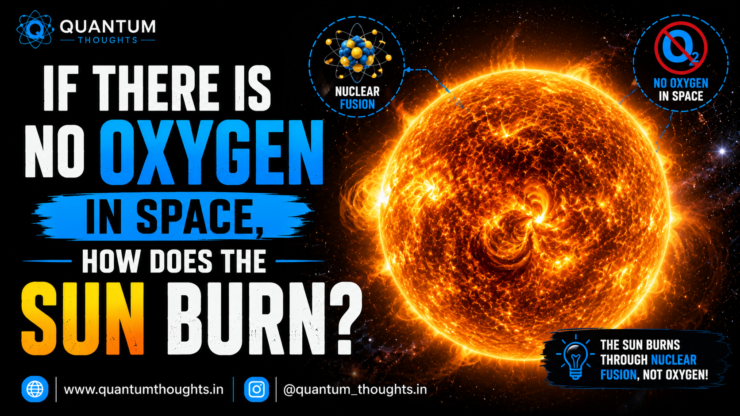
“Not everything that shines is burning. light is born from the laws of physics, not from fire.”
This question must have crossed almost everyone’s mind at some point.
We have learned since childhood that three things are necessary for a fire to burn : fuel, heat, and oxygen. So, knowing that there is virtually no oxygen in space, the question naturally arises:
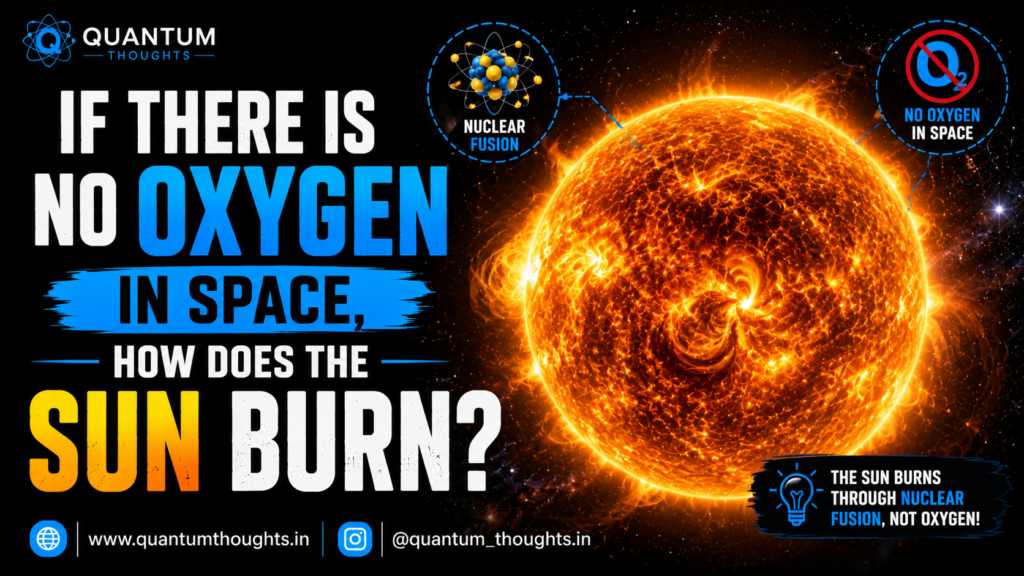
“If there is no oxygen in space, how has the Sun been burning for millions of years?”
This is very interesting question, but the answer is that the Sun does not actually burn like a fire.
The light and heat we experience every day to not come from ordinary fire, but from a distinct physical process known as nuclear fusion.
Let us understand this mystery in simple terms.
Is the Sun really fire?
When we look at campfire or a gas stove, it seems as though the Sun might be burning in the same way.
But this is a major misconception.
Fire is a chemical reaction in which a substance reacts with oxygen to produce heat and light.
For example :
- Wood burns.
- Petrol burns.
- Gas burns.
Oxygen is required for all these processes.
However, no such chemical process takes place in the Sun.
So, what happens inside the Sun?
The Sun is primarily composed of gases like hydrogen and helium.
The temperature at its core is approximately 15 million degrees Celsius.
At such extreme temperatures and pressures, hydrogen atoms fuse together.
This process is called nuclear fusion.
During this process, four hydrogen atoms combine to form a single helium atom.
In this process, a small amount of mass is converted into energy.
This very enegry is released in the form of light and heat.
What is nuclear fusion?
Nuclear fusion is the process where small atoms combine to form a larger atom.
A vast amount of energy is generated during this process.
Albert Einstein, in this famous equation:
E = mc²
It was shown that mass and energy can be converted into each other.
The same process is continuously taking place in the Sun as well.
Why does the Sun not need oxygen?
Because the kind of chemical reaction that produces fire does not occur in the Sun.
Atomic nuclei merge there.
This is a nuclear process.
It does not require oxygen for that.
Therefore, the Sun can continuosly generate energy even though there is no oxygen in space.
Can fire burn in space ?
If you take a piece of wood into space and try to burn it, what will happen?
The answer is – It will not be able to burn for long.
Because oxygen is not available there.
Therefore, ordinary fire cannot burn in space.
But the Sun is not an ordinary fire.
For how long has the Sun emitting light?
Accourding to scientists’ estimates, the Sun has been generating enegy through nuclear fusion for approximately 4.6 billion years.
And it is still has enough hydrogen left for approximately 5 billion years.
So, the Sun will continue to provide light and heat for a long time to come.
How does the sun shine on the earth?
People think that there is no air in space, so light can’t go through space.
But this is again a misunderstanding.
Light is not carried by air.
Light is an electro-magnetic wave.
It can move through empty space at the speed of light.
The light from the Sun takes about 8 minutes and 20 seconds to reach the Earth.
What if the Sun there was filled with oxygen?
That’s an interesting question.
Add oxygen to the Sun. It won’t just burn hotter, like any ordinary fire.
This is because conditions in the interior of the Sun are so extreme that nuclear processes dominate.
It doesn’t need oxygen for its energy.
Do other stars generate light similarly?
Yes. Yes.
Almost all stars in the universe generate light and heat through nuclear fusion.
This color, size, and lifespan may vary, but the fundamental source of their energy is fusion.
The Biggest Misconception
People often say :
“The Sun is a giant ball of fire.”
Scientifically, this statement is not entirely accurate.
The Sun is not a ball of flame.
It is a sphere of very hot plasma where nuclear fusion reactions are always taking place.
So in the interest of simple understanding the Sun is compared to fire, but this is not scientifically accurate.
What does this question teach us?
This question teaches us something important.
We often try to understand the entire universe based on everyday experience.
Because oxygen is necessary for fire on Earth, we assume that every bright object in the universe must work in the same way.
However, the laws of nature often differ for our everyday experiences.
The beauty of science lies in the fact that it explains the actual processes behind the things we see.










Add comment