

 Ravi Dangariya
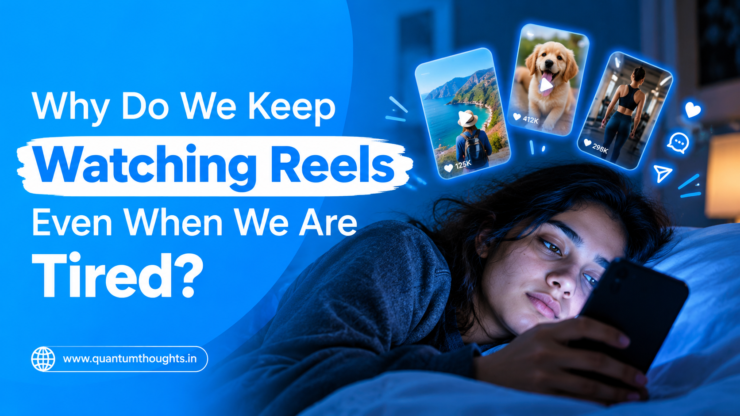
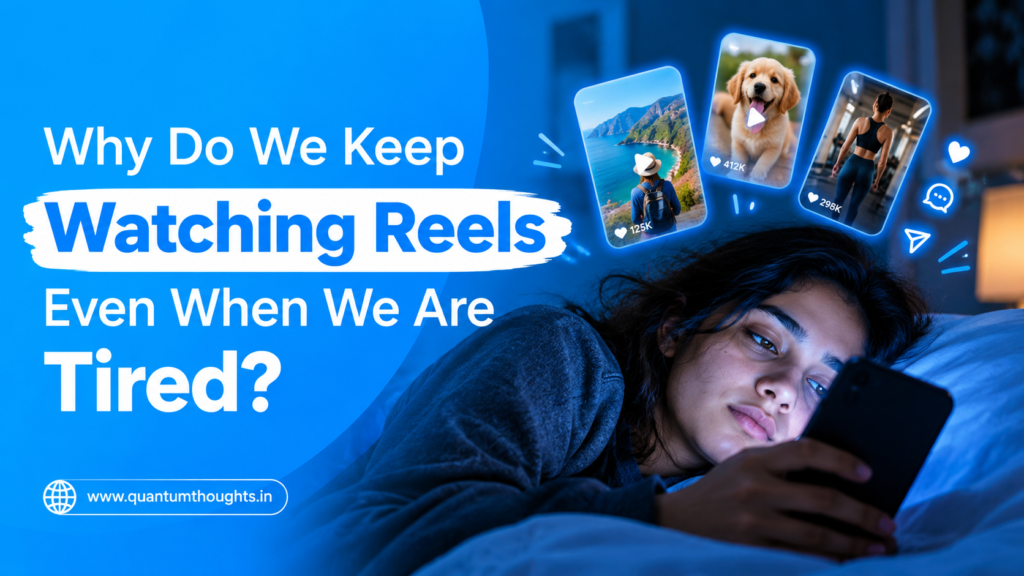
Sometimes, after working all day, we are exhausted.
Our eyes feel tired.
Our mind tells us we should put the phone away and go to sleep.
But we open Instagram and think—
“I’ll just watch one Reel and then put the phone down.”
One Reel ends.
Then another.
Then a third.
And after a while, we realize that 30 minutes or even an hour has passed.
The question is,
If we are truly tired, why can’t we stop watching Reels?
This isn’t just a matter of willpower.
Habit, reward, attention, and certain psychological tendencies of our brain also play a significant role.
We opt for simple things when we are tired.
When we work all day, our mental resources can become depleted.
These are the times when a book, a hard problem or an important decision seems like too much work.
Reels, in contrast, are very simple.
Just open your phone.
Watch.
Swipe.
Watch again.
No planning is required.
No intense concentration is needed.
That is why Reels seem like an easy entertainment option to a tired brain.
This leads us to think-
“I am just relaxing.”
But this is where an interesting cycle begins.
You get something new after every Reel.
A key feature of Reels is constant novelty.
One Reel might be comedy.
The next, psychology.
The third, news.
The fourth, a motivational video.
The fifth, unexpected content.
We don’t know what’s coming next.
It’s this unpredictability that keeps us watching.
If it was all the same Reels we’d get bored quickly.
But the hope of finding something new with every swipe keeps us swiping.
You might call it a kind of “just one more” cycle.
“This is the last one.”
Then, another.
“Okay, stopping for real now.”
Then, just one more.
Dopamine plays a role, too.
Dopamine is often called the “pleasure chemical”, but it does much more than that.
It is also linked to motivation, reward learning and anticipation.
Curiosity keeps us going, when we do not know whether the next reel will be interesting or not.
Perhaps the next Reel will be funnier.
Perhaps we’ll find something useful.
Perhaps we’ll find something we really like.
That feeling of “maybe” can be a big reason why we keep scrolling.
That is why we often keep scrolling—not for a specific Reel, but for the possibility of what we might find next.
“I should go to sleep now”-yet why can’t you put the phone down?
This is where habit plays a crucial role.
If you watch Reels every night after getting into bed, your brain gradually forms an association between the bed and scrolling.
Consequently, when you get into bed, your hand automatically reaches for the phone.
It becomes an automatic behavior rather than a conscious decision.
That is why you might open Instagram without even thinking about it.
This is precisely why, often, it is only after picking up the phone that we realize—
“I hadn’t actually come here to look at anything.”
Being tired and being sleepy are not the same thing.
This is also important.
The body might be exhausted, yet the mind may still be seeking stimulation.
For some people, scrolling becomes a form of mental escape after a long day of work.
They tend to think:
“The day wasn’t mine. Now, let me spend some time on my own terms.”
This is sometimes linked to “revenge bedtime procrastination.”
In this scenario, even though a person knows they need to sleep, they delay it to carve out some personal time for themselves.
Reels can serve as a very easy tool for this.
Do Reels provide us with rest, or do they merely distract us?
This is a crucial question.
Reels can temporarily take us away from stress.
However, distraction and genuine rest are not the same thing.
If we do not feel mentally refreshed even after watching Reels for 45 minutes, then perhaps we haven’t truly rested.
We have simply shifted our attention from one piece of content to another.
Sometimes, the body needs rest.
Sometimes, the mind needs peace.
And sometimes, we simply need to stay away from the screen.
The “Just One More Reel” Trap
The most common trap with Reels is—
“Just one last Reel.”
This is because there is no clear ending.
A movie comes to an end.
A book chapter concludes.
But with Reels, as soon as one ends, another is immediately available.
Consequently, our brain cannot naturally find a stopping point.
The scrolling continues.
Therefore, if we don’t decide to stop beforehand, the platform’s endless stream of content can easily override our decision-making.
How can you change this habit?
First, ask yourself a question before unlocking your phone:
“What am I actually unlocking my phone to do right now?”
If there is no specific reason, you might be unlocking it out of habit.
Second, cut back on the habit of keeping your phone in bed.
Third, set aside some screen-free time before going to sleep.
Fourth, if you watch Reels, try using a timer or setting a predetermined stopping point.
And most importantly-
You don’t have to rely on willpower every single time.
You can also change your environment.
Small steps-like keeping your phone a bit further away, turning off notifications, or removing distracting apps from your home screen-can also help.
Sometimes we keep scrolling not because we are enjoying it, but because we have forgotten how to stop.
💭 Do share your experience in the comments:
Do you also often start scrolling by saying “just one Reel,” only to find that far more time has passed than you intended?
In your opinion, do we keep watching Reels because we enjoy them, or because our brains are constantly seeking something new?
Written by Ravi Dangariya(Rick Patel)







Add comment