

 Ravi Dangariya
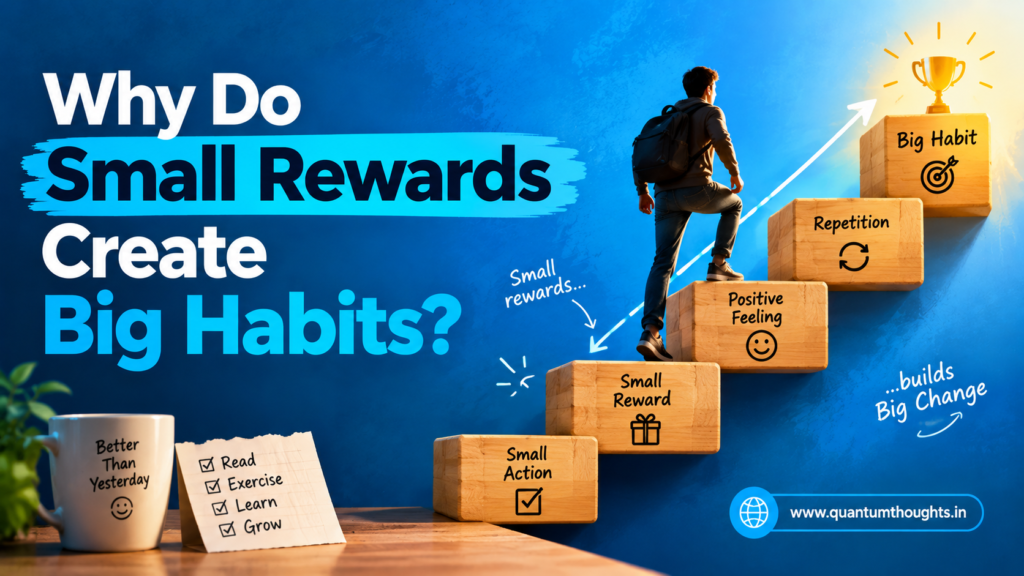
How small rewards turn our small habits into big parts of our lives? Understanding the psychology of habit formation can help to reveal the science that explains how routines become ingrained. If you want to build habits that stick, it’s important to understand the psychology of habit formation.
Ever thought about why we do certain things over and over?
When a notification comes up we check our phones. This is an example of the psychology of habit formation in everyday life.
We want to watch another one when we see a new ‘Reel’.
Sometimes we even feel happy after completing a small task.
There may be an interesting psychological mechanism at work here.
It’s the ‘Reward System’.
The more pleasure, satisfaction or relief an action provides us, the more likely we are to do it again.
This little behaviour can become a habit little by little.
Reward System: Why Does the Brain Like Rewards?
Our brain learns from experiences that have some sort of benefit or satisfaction attached to them.
Say you’ve accomplished a hard job.
You get a feeling of satisfaction when you complete it.
This experience can motivate you to do the task again in future.
Likewise, the satisfaction of completing a small task can be fulfilling.”
If a behaviour leads to a positive outcome, the chances of that behaviour being repeated increase.
The notion of ‘ reinforcement ’ is helpful in explaining this .
But a reward is not always a monetary reward or a gift .
Sometimes, a sense of satisfaction, appreciation, or visible progress can also be a reward. In fact, psychology of habit formation teaches us that small rewards and recognition can be very powerful reinforcers of desirable actions.
Dopamine: What Lies Behind Small Rewards?
Dopamine is a brain chemical known as a neurotransmitter.
It plays a very important role in processes such as motivation, learning and reward.
If we anticipate something to be rewarding, the dopamine related mechanisms can make us go for it.
Suppose you are waiting for a message on your phone.
You get a notification and you feel like you have to open your phone.
The message could be of interest. Or it might not.
But the anticipation of what is about to come can make us check the phone.
Thus, not only the reward itself but the expectation of reward can influence our behaviour.
How do small rewards lead to the formation of a major habit?
Say you want to start reading every day. Psychology of habit formation tells us that starting small and building up is very effective to establishing consistency.
If you start with a goal of reading 50 pages each day, you might start to get tired after a few days.
But if you decide that you are going to read just five pages a day, it is much easier to begin.
You write those five pages, and you have a small feeling of success.
This experience can make you want to read the next day again.
Doing something small frequently eventually makes it a habit.
The Habit Loop: Trigger, Action, and Reward
The idea of “habit loop” is useful to understand how habits are created.
It is comprised of 3 parts:
Cue: A signal to initiate a behaviour.
Habit: The act itself.
Reward: The outcome or satisfaction gained as a consequence of the behaviour.
For example, suppose you have finished your morning tea and you start reading a book.
Here , finishing the tea serves as the cue .
The usual way is to read the book.
And the prize is the joy of understanding something new.
Repeating this process can help develop a reading habit.
But not all habits can be explained entirely by these three elements. Also, our surroundings, our feelings and our social environment are involved.
How to Use Small Rewards for Good Habits?
Small rewards are easily added to your daily routine.
- Start small : Dedicate yourself to 10 minutes of walking each day .
- Track your progress: Keep a record of how many days in a row you have walked.
- Celebrate every small victory: Experience a sense of satisfaction when done.
- Make it easy to build the habit: If you want to read, put the book where it is easy to see.
- Miss a day, start again: Don’t see a one-day lapse as the failure of the whole habit.
Remember that a reward doesn’t always have to be from the outside.
Sometimes it’s enough to look back and see how far you’ve come and how hard you’ve worked. So, simply put, the psychology of habit formation teaches us how internal and external rewards combine to create lasting habits.
Small rewards can make progress feel meaningful, one repeated action at a time.
If you liked this article, please share your thoughts in the comments. 💭
In your opinion, what is more important for developing a good habit: motivation, or the satisfaction derived from small successes?
Written by Ravi Dangariya (Rick Patel)




 ravidangariya539@gmail.com





Add comment