

 Ravi Dangariya
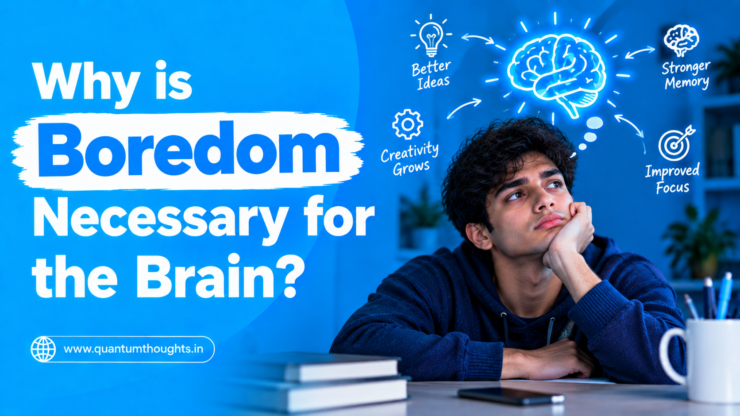
These days the moment we get a little bored we reach for our phones. Some check messages, some open Instagram, some start watching Reels.
We tend to think of boredom as a waste of time. But is it?
Boredom can be harmful to our brains or it can be an opportunity for the brain to work differently.
But not always is boredom a bad thing. In the right circumstances, it can help us understand our inner thoughts, generate new ideas and recognize what really matters in life
What exactly is boredom?
Boredom is a state of mind that we lose interest in what we are doing, have difficulty concentrating or want to do something different.
We get bored when something is not interesting enough or challenging enough.
But we get bored not just when we are not doing anything, but often when we have been using our phones non-stop.
This is because a brain that is constantly being fed information and a brain that is having a satisfying experience are two different things.
Yes, watching a lot of Reels may keep the brain busy, but that doesn’t mean our attention or mind is really resting.
Boredom gives the mind space to think.
When we are constantly engaged in a task, our attention is mostly focused on that activity.
But when external stimulation fades, we can turn inward, to our own thoughts, memories and experiences.
For instance, an old memory can suddenly come up when you are alone or walking without a purpose. It can be a new solution to a problem, or it can make you start thinking about your life.
In this state the brain’s “Default Mode Network” (DMN) can become active. Such a network is involved in processes such as self-related thinking, memories of the past, and imaginings of the future.
But it’s not the case that the DMN always lights up when one is bored, nor does it always lead to a useful idea.
The point is that we don’t have to fill up every idle moment with information.
How can boredom foster creativity?
You don’t get imagination simply from having information, sometimes it takes a while to connect existing knowledge to new ideas.
Imagine you’re trying to solve a problem. You think and think, but you can’t come up with an answer.
Then you stop, perhaps to walk around or do something easy. And then you get a new idea.
This is often referred to as the “incubation effect” — the idea that taking a break from a problem can sometimes lead to a new solution.
Boredom, on its own, does not guaranty creativity. But unstructured free time can give us the opportunity to find new links between ideas.
That is why it is not necessary to be seeing, hearing or doing something every moment.
It is not necessary to ward off every moment of boredom with a phone.
When we’re waiting for an elevator, or waiting for someone, or sitting on a bus, we reach for our phones right away.
We try to stave off boredom before we even really experience it.
Little by little we begin to find it hard to do nothing for a short time.
But an important question is, do we really need to look at something, or do we just want the pain of having nothing to do?
It’s not always wrong to use a phone. With it we learn, we connect with others and we access useful information.
The problem comes when we start using the phone on autopilot, in every spare moment.
Sometimes it helps to stop for a second before dialing the phone and ask yourself: “What do I really need right now?”
What is the difference between boredom and overthinking?
Boredom can be an opportunity to reflect, but this doesn’t mean the more you think, the greater the benefit.
Quiet sitting allows a person to see his problem from another angle. Alternatively, you can get stuck in overthinking where you keep reliving the same negative thought.
For example, a thought like “How can I find a solution to this problem?” can help you to move forwards.
But when thoughts such as “Why does this happen only to me?” or “What if everything goes wrong?” keep circulating without any clarity, they can contribute to mental fatigue.
So, it is not necessary to chase after every single thought to make boredom productive. It is important to notice the thoughts as they come into your mind and to move your attention to another task when needed.
Simple ways to embrace boredom
Instead of rushing to eliminate boredom, we can adopt a few small habits.
- Sit for a little while without your phone Spend five or ten minutes doing nothing in particular.
- Take a walk: Don’t always be on your phone or listening to music while walking, look around.
- Write down your ideas: When a thought or question occurs to you, write it down.
- Do something creative: Write, draw or work on a new idea.
- Don’t strain yourself: You don’t have to come up with a brilliant idea in your free time.
You don’t have to stand for boredom. If you’re doing something that feels uninteresting for a long time, there’s nothing wrong with looking for another activity and moving your body or finding something meaningful to do.
Are we wasting our time in boredom, or is boredom a way to know ourselves?
“Productivity is often measured by how busy our day was.
But busyness and meaningful work aren’t the same thing.
We have moments to rest. Some help us to understand ourselves. And some show whether we really care about what we are doing or we just keep doing it out of habit.
Boredom can also drive us to seek things to do. It can also be a chance to think about our own needs and desires.
But boredom can be a bad thing. Quite different are such things as a persistent boredom, a lack of interest in things, or a prolonged sense of apathy. In such cases, it is better to understand the root causes and seek professional help from a mental health professional if needed.
Not every empty moment needs to be filled; sometimes, the mind needs space to discover something new.
Do share your thoughts in the comments:
When you feel bored, do you immediately pick up your phone, or do you prefer to spend some time with your own thoughts?
In your opinion, is boredom truly a waste of time, or is it an opportunity to understand yourself better?
Written by Ravi Dangariya(Rick Patel)









Add comment