

 Ravi Dangariya
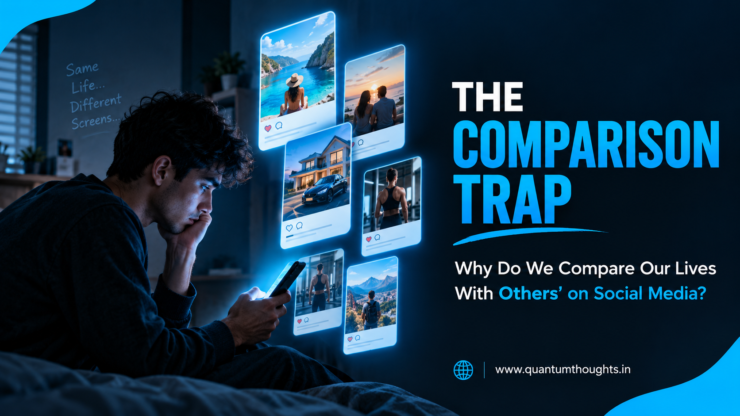
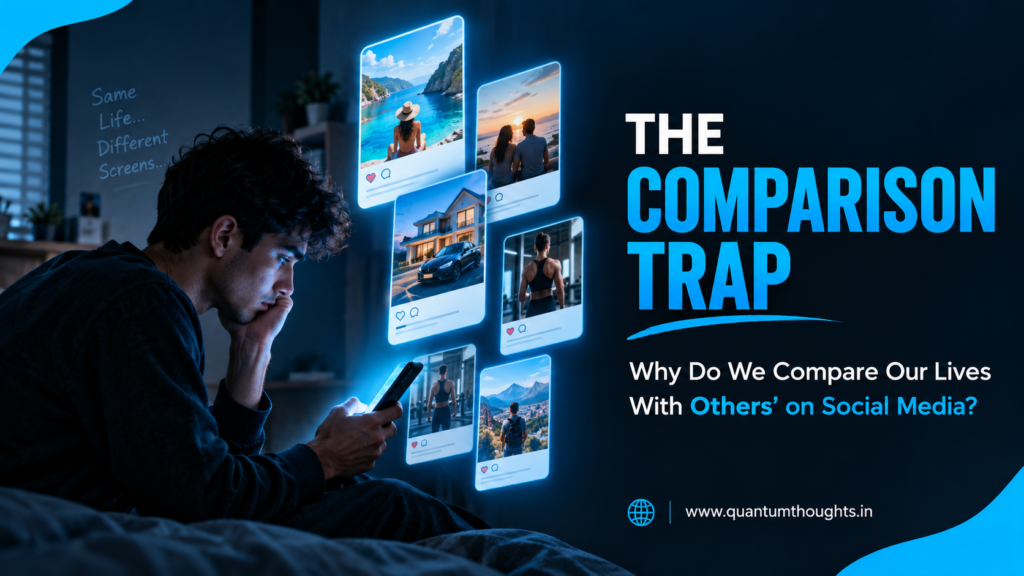
We often compare our reality with someone else’s carefully edited version of reality.
Scrolling through Instagram or Facebook and saw someone’s success, beautiful home, travels, relationship, or lifestyle and thought to yourself
Why does my life not look like that?
It was all fine just a few minutes ago. But when we look at other people’s lives we start to feel that we are missing something in our own.
This is the “Comparison Trap.”
It’s natural to compare ourselves with others. However, social media has made this comparison much easier, faster and constant.
Why do we compare ourselves with others?
The human brain naturally compares itself to others in order to understand itself.
This is called in psychology “social comparison”.
When we think:
They are more successful than me.
“Their life is better.”
“They are more confident than I am.”
“They are achieving so much, while I am… where?”
…we begin to measure our own situation against theirs.
The problem does not always lie in the act of comparison itself.
The problem arises when we compare the visible aspects of someone else’s life with the full reality of our own.
Why does social media make this trap even bigger?
On social media, we generally do not see the full reality of people’s lives.
We see-
Success.
Travel.
A new car.
Beautiful photos.
Relationship moments.
Fitness transformations.
Career achievements.
But we generally do not see-
Their anxiety.
Failures.
Financial problems.
Relationship problems.
Self-doubt.
Loneliness.
The hard work put in behind the scenes.
Or how insecure they feel about themselves.
In other words, we are looking at their “highlight reel” and comparing it to our own “behind-the-scenes” reality.
This comparison is unequal from the very start.
Why can upward comparison make us unhappy?
When we compare ourselves to someone who appears more successful or better-looking, it can be termed “upward comparison.”
This type of comparison can sometimes provide motivation.
For example:
“If they can learn it, I can learn it too.”
However, if our focus shifts from inspiration to a sense of inadequacy, our mindset changes:
“They can do it; why can’t I?”
This is where our self-esteem begins to be affected.
Instead of considering others’ success as their journey, we start considering it as our failure.
Comparison and Self-Esteem
The biggest issue is when we base our self-worth on comparing ourselves to others.
Just because someone is ahead of us, it does not necessarily mean we are lagging behind.
Life is not a race where everyone starts from the same point.
Some people achieve success at the age of 25.
Others after 35.
Some after 45.
One person may be climbing up the ladder of career success and another is still battling their own demons.
So comparing the “timelines” of two people is often unfair.
FOMO can lead to comparison, too.
Constantly seeing others doing things on social media can trigger FOMO-the Fear of Missing Out.
“Everyone is moving ahead.”
“Everyone is having a good time.”
“Everyone has friends.”
“Everyone is traveling.”
“I should be doing something too.”
But “everyone” isn’t actually everyone.
We only see the people who are sharing something.
We don’t see the person sitting quietly in their room who isn’t posting anything.
So social media can never provide a complete picture of the world.
How do you get out of the comparison trap?
First, if you feel bad after seeing someone’s post, ask yourself:
“Am I feeling bad about their success or am I comparing myself to them?
This question can bring awareness.
Second, do not mistake what you see on social media for the whole reality.
Third, start comparing yourself to your own progress.
What did I learn today compared to yesterday?
How has my thinking improved?
What has changed in my habits?
How much closer am I to my goals?
This kind of comparison is far more useful.
Because your true competition is often not another person…
…but the version of yourself from yesterday.
Is quitting social media the only solution?
Not necessarily.
Social media itself is not the problem.
The problem lies in how we use it.
If you find that a particular account consistently makes you feel inadequate, anxious or unhappy, then it’s probably best to mute or unfollow it.
Your feed controls your attention and emotions.
So sometimes changing your digital environment can be a form of self care as well.
Written by Ravi Dangariya(Rick Patel)
💭 Share your thoughts too:
Which idea resonated with you the most after reading this article? Do share your experiences or thoughts in the comments. Perhaps a comment from you might inspire another reader to reflect on something.
In your opinion, does comparing ourselves with others on social media motivate us, or does it leave us feeling dissatisfied with ourselves?








Add comment