

 Ravi Dangariya
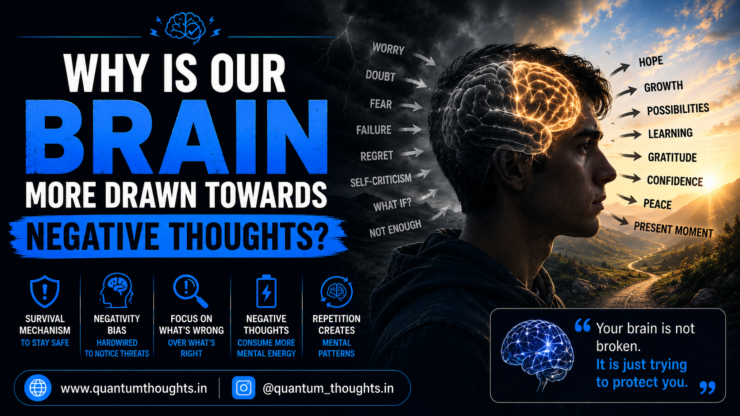
The mind often remembers what hurt us faster than what made us happy.
Sometimes, many good things happen during the day, yet our attention gets fixated on a single negative event.
Someone might have praised us, but the criticism from one person stays on our mind all day long.
Even when ten things are going well, a single problem keeps playing over and over in our thoughts.
Why does this happen?
Is our brain naturally drawn more towards negative thoughts?
The answer is—to a large extent, yes.
The human brain is prone to focus more rapidly on negative information. In psychology, this is called “negativity bias”.
What is Negative Bias?
Negativity Bias refers to our brain’s tendency to place greater importance on and remember for longer negative experiences, information, or events compared to positive ones.
For example, suppose someone tells you:
“You did a great job.”
But then adds:
“However, there is some room for improvement here.”
It is quite possible that you will remember the final criticism more than the praise that preceded it.
This does not mean that our brain is inherently negative.
Its primary function is to keep us safe.
Recognizing danger was a necessity for survival.
Why does our brain catch on to the negative so quickly?
For our ancestors, the ability to identify danger could mean life or death.
Ignoring an unfamiliar sound in the forest could be dangerous.
But if the brain immediately thought,
“There might be a danger here,” then the person could become alert.
Thus, quickly focusing on negative or threatening information became a survival strategy for the brain.
In today’s world, we do not need to protect ourselves from predatory animals in the forest.
However, our brain still operates using that ancient mechanism designed to quickly detect danger.
The nature of danger has now changed.
A harsh message, criticism on social media, uncertainty in a relationship, or even anxiety about the future can become significant threats to the brain.
Why does a negative thought persist throughout the day?
A negative thought does not remain just a single thought.
Often, it gives rise to other thoughts.
Suppose someone didn’t reply to your message.
Your first thought might be:
“Maybe they are busy.”
But after a while, your mind says:
“Maybe they don’t want to talk to me.”
Then:
“Did I do something wrong?”
And finally:
“Maybe no one likes being with me.”
A small incident can trigger a chain of negative thoughts.
The problem here isn’t the incident itself.
The problem lies in how our mind interprets that incident.
We attach greater importance to negative thoughts.
The brain does not treat all thought equally.
Negative thoughts are often more emotionally charged.
Hence a harsh word may be remembered for years, while a kind word from someone may be forgotten in a couple of days.
This is especially true when we are already under stress or in a state of uncertainty.
The more tired the mind is, the more quickly it tends to lean towards negative interpretations.
Social media can also amplify this tendency.
Now, not only do we have negative information around us,
It’s always coming at us via our phones too.
When we see conflict in the news, criticism, comparisons, arguments, and shocking content on social media, we are listening.
This is because negative and emotional content is more likely to grab our attention.
If we constantly consume such information, our minds may begin to view the world in a more negative light.
That is why an “information diet” is also important.
Just as what we feed our bodies matters, what we expose our minds to is equally important.
Are negative thoughts bad?
Not every negative thought is bad.
Some negative thoughts help us identify a problem.
“If I don’t prepare for this task, a problem might arise.”
This thought can motivate us to prepare.
The problem begins when the thought causes us to worry constantly instead of solving the issue.
Problem-solving and overthinking are not the same thing.
Problem-solving asks:
“What can I do now?”
Overthinking keeps asking:
“What if this happens?”
“What if things go wrong?”
“What will happen then?”
And this cycle continues.
What should you do about negative thoughts?
The first step is to recognize the thought.
You don’t have to believe a negative thought when it first comes into your mind.
Ask yourself:
“Is this a fact, or just my thought?”
Then ask:
“What evidence supports this thought?”
And:
“Is there another, more balanced way to view this situation?”
These questions can help your mind step back a little from the thought.
The second important step is to rebalance your attention.
Consciously notice the good things that happen during the day as well.
Don’t let help received, an opportunity, a small achievement, or a moment of peace simply pass by.
You can train your brain to notice positive things as well.










Add comment