

 Ravi Dangariya
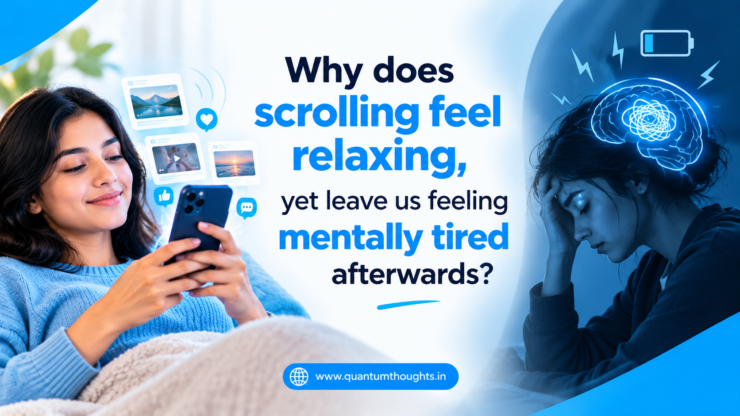
Sometimes, after working all day, we feel tired and think-
“Let me watch some Instagram or YouTube Shorts; then I’ll relax.”
We pick up the phone.
One Reel.
Then another.
Then a third.
And we don’t even realize when 30 minutes or an hour has passed.
At that moment, it feels like we are relaxing.
But often, after putting the phone down, it feels as though our mind is still tired.
So the question is-
If scrolling relaxes us, then why do we end up feeling mentally tired?
Why does scrolling make us feel relaxed?
When we are tired, our brain does not want to engage in tasks that require significant effort.
Reading a book, solving a problem, or making a serious decision demands mental effort.
In contrast, scrolling is very easy.
We simply have to look at what appears on the screen and then swipe.
No planning is required.
No specific decisions need to be made.
That is why scrolling feels like a low-effort activity.
It can briefly divert our attention away from work, stress, or our thoughts.
For this reason, scrolling feels relaxing.
However, there is an important distinction to be made here.
Just because something is distracting, it does not necessarily mean it is also mentally restorative.
Attention gets no rest.
When we scroll, our brain is constantly processing new information.
One video.
Then an image.
Then some news.
Then a joke.
Then an advertisement.
Then some emotional content.
A new stimulus arrives with every swipe.
To us, it all feels passive, but for the brain, it involves constantly changing information.
So, while the body might be resting on the sofa, our attention is constantly at work.
This is a key reason why the mind can feel tired even after scrolling.
Novelty grabs our attention.
On social media platforms, we encounter something new after every swipe.
This novelty naturally captures our attention.
We do not know what will appear next.
Sometimes a funny video.
Sometimes interesting information.
Sometimes an emotional story.
Sometimes something we can personally relate to.
This unpredictability keeps us scrolling.
We often do not consciously decide,
“Now I will scroll for another 20 minutes.”
We simply keep swiping, one after another.
What is mental fatigue?
Mental fatigue does not simply mean feeling sleepy or physically exhausted.
Sometimes, it can manifest as-
- Difficulty concentrating
- A lack of desire to read anything
- Reluctance to make decisions
- A feeling of being overwhelmed by too much information
- No motivation to start any meaningful task
We often wonder:
“I haven’t really done anything special today, so why am I mentally tired?”
However, mental effort is not always as visible as physical activity.
What happens to the brain when we constantly switch content?
While scrolling, we do not dwell on a single thought for long.
We move from one topic to another.
From one emotion to another.
From one story to another.
This constant switching prevents our attention from remaining steady.
And later, when we sit down to read a book, work, or engage in deep thinking, our mind may repeatedly crave stimulation.
Focusing calmly on a single thing can feel difficult.
This raises an interesting question:
Are we truly resting, or are we merely shifting our attention from one stimulus to another?
Scrolling and Boredom
Nowadays, even boredom makes us feel uncomfortable.
Standing in an elevator?
Phone.
Waiting for someone?
Phone.
Finished a meal?
Phone.
Sitting idle for a bit?
Phone.
In this way, we start filling every small, empty moment with scrolling.
But boredom isn’t always bad.
When we aren’t constantly receiving information from the outside, our mind gets the chance to engage with its own internal thoughts.
Sometimes, this kind of mental space is essential for creativity, reflection, and problem-solving.
The Difference Between Relaxation and Distraction
To understand this, keep a simple distinction in mind:
Distraction takes you away from a thought.
Rest gives your mind a chance to recover.
Scrolling can sometimes work very well as a distraction.
If you’ve had a stressful day, a little entertainment isn’t a bad thing.
The problem arises when scrolling becomes our default form of relaxation.
Phone after every stressful moment.
Phone after every moment of boredom.
Phone after every uncomfortable emotion.
That is when we risk developing a habit of constantly distracting ourselves instead of processing our emotions.
Should social media be completely given up?
Not necessarily.
Social media offers many positive aspects, too.
Knowledge.
Entertainment.
Connection.
Creativity.
Community.
The problem does not lie in the existence of social media itself.
Often, the issue lies in its unconscious use.
So, rather than asking, “Should I use social media or not?”, a more useful question is:
“Why am I opening social media?”
If the answer is—
“I want to look at something specific.”
…then you are likely using it consciously.
But if the answer is—
“I don’t know; I just opened my phone.”
…then habit is likely driving your actions.
How can you make your scrolling more conscious?
You can try a few small experiments.
Before unlocking your phone, ask yourself:
“What am I looking for right now?”
Secondly, set aside some intentional time for scrolling.
Thirdly, carve out some screen-free moments during the day.
For instance, while having tea.
While eating.
Before going to sleep.
Or while waiting for someone.
And most importantly—
You don’t always need to fill moments of boredom with your phone.
Make some room for a little quiet, too.
Not every moment of silence needs to be filled; sometimes the mind needs space, not more content.
Share your experience too:
After reading this article, which thought about scrolling resonated with you the most? Do share your experience or thoughts in the comments. Perhaps your comment might inspire another reader to reflect on their own scrolling habits.
In your opinion, do we use social media because we genuinely want to see something, or simply to escape boredom and stress?
Written by Ravi Dangariya(Rick Patel)









Add comment