

 Ravi Dangariya
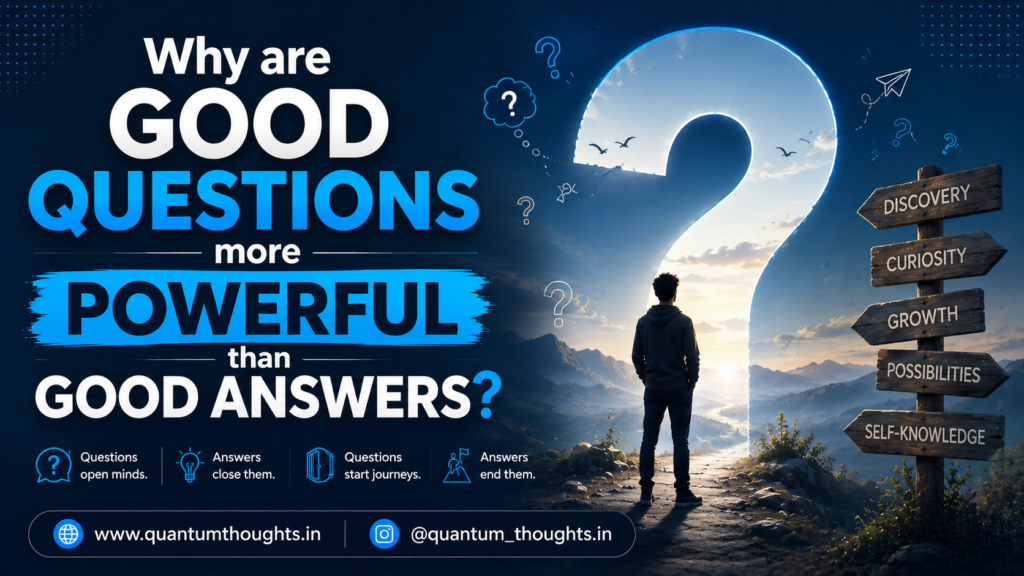
Answers may end a conversation, but question have power to transform a mind.
In childhood, we constantly ask questions
Why is the sky blue?
Why do stars appear only at night.
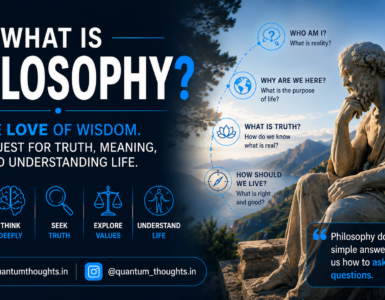
Who am I?
These questions were not merely born of curiosity; they marked the beginning of learning. As we get older, we tend to put a premium on memorizing answers rather than asking questions, But history shows that it was questions, not answers, that moved humanity forward.
Newton asked, “Why does the apple fall down?” This question led to the theory of gravity.
“What happens if I go at the speed of light?” Einstein asked. This question set modern physics on a new course.
This shows how often the right question can usher in a new age.
Questions initiate the process of thinking.
Answers provide us with information, whereas questions compel us to think.
If someone asks you a question, your brain immediately attepts to find an answer. Thus, a question does not merely seek information; it activates the thinking process.
A good question teaches us to think for ourselves instead of accepting ready-made answers.
A new question arises after every answer.
Many people believe that the answer is the ultimate goal. But in reality, every answer marks the beginning of new question.
When humanity discovered that the Earth revolves around the Sun, the question arose: could there be life on other planets as well?
When the atom was discovered, the question arose: what lies inside it?
The advancement of knowledge is made possible only by constantly asking questions.
Questions teach us to examine our beliefs.
Many of us never question our own beliefs.
But true understanding begins when we ask:
- Why do I believe this?
- What is the basis for this idea?
- Could I be wrong?
Such questions teach us to think with a more open mind.
Often, the biggest change comes not from a new answer, but from a new question.
Questions lead to self-knowledge.
Asking questions within oneself is just as important as asking questions about the outside world.
- What do I truly want?
- Am I making a decision out of fear or understanding?
- Are my thoughts always right?
- Am I equating my identity with my thoughts?
Answers to such questions are not found immediately, but they lead us deeper within ourselves.
Both science and philosophy begin with questions.
Science does not accept any claim based on blind faith. It questions every claim and asks for evidence.
Philosophy teaches that what is visible is not always the whole truth.
Socrates believed that true wisdom begins with recognizing one’s own ignorance. Therefore, instead of giving direct answers to people’s questions, he would ask questions that prompted the other person to think for themselves.
Questions can change our perspective.
Suppose a difficulty arises in your life.
You can ask two questions.
“Why did this happen to me?”
Or,
“What can I learn from this experience?”
The situation remains the same.
Only the question has changed.
But this single question can transform your entire perspective.
Often, the quality of our lives depends more on our questions than on the situation itself.
Not every question needs an answer.
There are some questions in life for which answers are not found immediately.
Who am I?
What is the purpose of life?
What is consciousness?
Perhaps the purpose of such questions is not to find an answer, but to make us more aware.
Some questions stay with throughout our lives, and their meaning shifts with every new experience.







Add comment