

 Ravi Dangariya
Your brain is not permanently wired. Every meaningful experience has the potential to reshape it
We often believe that once the brain develops, it does not change.
There was a time when scientists held the same belief.
Modern neuroscience, however, has changed this perception.
Today we know our brain can change throughout our lives.
This amazing feat is called neuroplasticity.
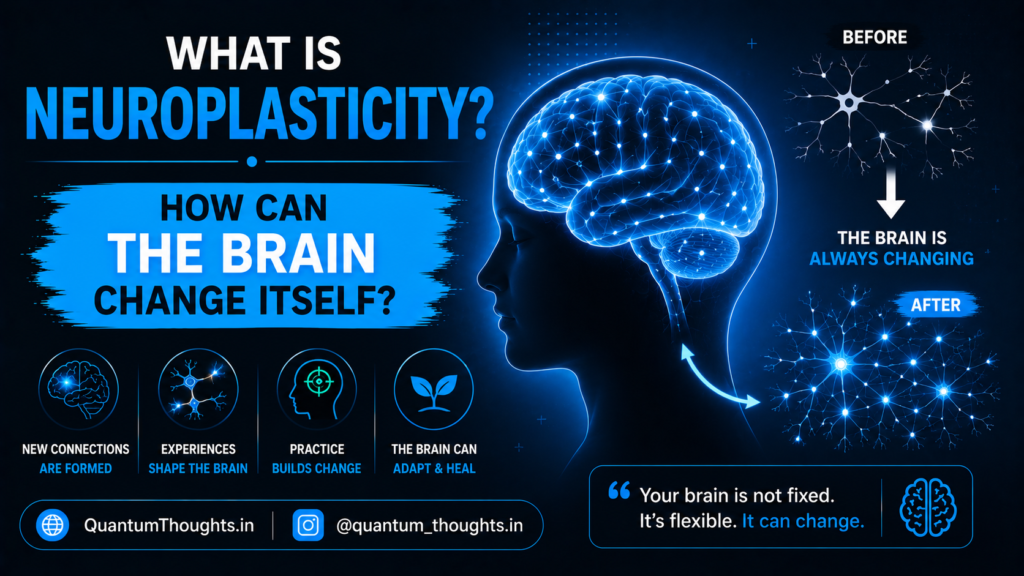
Simply put, neuroplasticity is the brain’s ability to change its own structure and function due to experience, practice and circumstances.
What is neuroplasticity –
There are billions of neurons in our brain.
These neurons are connected to each other.
“They’re always trading information.
These connections are altered with new learning.
Some connections become stronger.
Some become weaker.
This ongoing process is called neuroplasticity.
What was thought before.
For many years scientists thought that the brain did not change much after we reached adulthood.
If a part was damaged it was considered permanently lost.
But it has been shown that the brain can find new ways of working.
Sometimes other parts can even help with the lost function.
It was a discovery that changed neuroscience profoundly.
What changes in the brain?
And as you learn the same thing over and over again, the connections between the relevant neurons start to get stronger.
This can be understood simply.
Imagine there is no path in a forest.
If one person walks through, only footprints are visible.
If people walk the same path everyday , a clear path is formed .
The same is true in the brain.
The pathways in your brain related to thoughts and actions that you do a lot get stronger.
A simple example
When you learn to ride a bicycle for the first time, maintaining balance feels difficult.
Many mistakes are made.
But after consistent practice, that same task becomes easy.
Not because the bicycle changed.
But because your brain became more efficient.
This is a simple example of neuroplasticity.
How are new habits formed?
Many people think that habits change solely through willpower.
However, habits are also formed in the brain through neural pathways.
If you read a book every morning, it begins to feel natural after a while.
Similarly, if you think negatively every day, that too can become a strong mental pattern.
The good news is that these patterns can be gradually changed through new practices.
Can bad habits also change?
Yes.
This is the most promising aspect of neuroplasticity.
Old neural pathways can weaken over time.
New pathways can become stronger.
But three things are necessary for change:
- Consistent practice.
- Patience.
- Repetition.
A single day’s effort is not enough.
The brain changes gradually.
Can the brain still learn as we age?
Yes.
The brain changes more rapidly during childhood.
But that does not mean learning is impossible in adulthood.
Learning a new language.
Playing a musical instrument.
Developing a new skill.
All these activities can stimulate the brain to function in new ways at any age.
Neuroplasticity and Meditation
Many studies suggest that regular meditation may be linked to functional changes in certain parts of the brain.
Specifically, there have been changes in areas such as emotional regulation and self-awareness.
That does not mean meditation is magic.
But doing it regularly can have a beneficial effect on the brain.
Is enough with positive thinking?
No.
Merely thinking does not change the brain.
Experience and action are necessary for change.
If you simply say, “I have learned a new language,”
the brain will not change.
But if you practice every day, new neural connections will gradually strengthen.
A thought can be the beginning.
Change comes from consistent action.
How can you harness neuroplasticity?
If you want to take advantage of this brain capability, a few simple habits can help.
- Learn something new every day.
- Read regularly.
- Try to learn a new skill.
- Exercise.
- Get enough sleep.
- Practice meditation or mindfulness.
- Do not repeat the same mistake; instead, learn from it.
All these practices help keep the brain active.
Neuroplasticity: Does it mean endless potential?
Nope.
Claims are sometimes made on social media that, thanks to neuroplasticity, we can learn anything very quickly or transform completely in just a few days.
This claim is not true.
The brain can change.
But it also has its own biological limitations.
Change takes time, practice and the right circumstances.










Add comment