

 Ravi Dangariya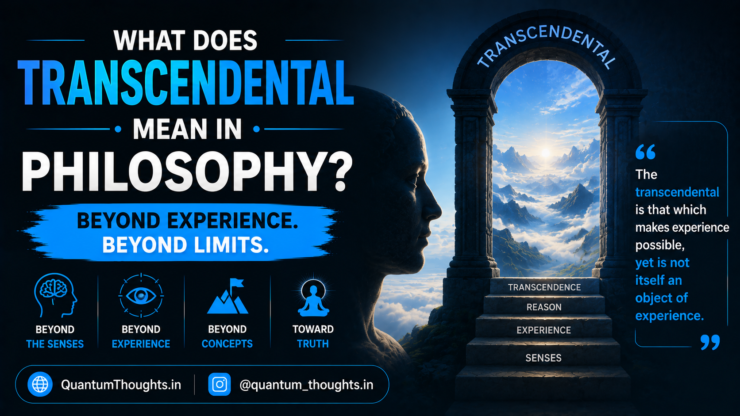
“To understand reality, we must first understand the mind through which reality is experienced.”
Upon hearing the word “transcendental,” many people immediately think of meditation, mysticism, or spirituality. However, in philosophy, the term holds a somewhat different meaning.
The German philosopher Immanuel Kant, in particular, gave this term a new depth. According to his ideas, “transcendental” does not refer to something supernatural or miraculous, but rather to a question:
“How is it possible for us to have any experience?”
This question is one of the most important questions in philosophy.
The Simple Meaning of “Transcendental”
Generally, “transcendental” does not mean we are talking about something mysterious that lies outside the world.
In philosophy, it refers to:
The fundamental conditions that make our experience possible.
In other words, what mental structures are at work behind the way we experience the world?
A simple example
Suppose you are wearing a pair of glasses.
You view the entire outside world through those glasses.
You see trees, roads, and the sky.
Yet, often, you completely forget about the glasses themselves.
Kant says that our mind functions much like such a pair of glasses.
We do not see the world directly.
We perceive experience as it is structured by the mind.
Thus, transcendental philosophy seeks to understand the structure of experience before examining the world itself.
Kant’s Most Important Thought
Prior to Kant, many philosophers believed that the mind simply takes in information from the outside world.
But Kant argued that the mind doesn’t merely receive information.
And it organizes that information.
According to him, our mind employs certain fundamental structures to make sense of experience.
For example:
- Time
- Space
- Cause and Effect
These concepts do not exist solely in the external world.
Our mind uses them to comprehend experience.
Can we know reality directly?
Kant’s answer was—perhaps not.
He introduced two important terms:
Phenomenon – the world as we experience it.
Noumenon – the thing as it is in itself.
According to Kant, we can only know the phenomenon.
This is because every experience passes through the structures of our mind.
We cannot say anything with absolute certainty about the noumenon.
A simpler example:
Suppose a person is wearing red-tinted glasses.
Many things will appear reddish to them.
Now, the question is:
Is the world truly red?
Or does it appear that way because of the glasses?
Kant says that our mind, too, organizes experience in a specific way.
Therefore, the world we see is always a world interpreted by the mind.
Does “transcendental” mean spiritual?
This word is often associated with meditation or mysticism.
In philosophy, Kant’s concept of the transcendental relates, for the most part, to knowledge and experience.
His aim was not to prove the existence of any supernatural power.
His question was simply this:
“If we are able to know anything at all, how is that possible?”
Why is this idea important today?
This idea remains highly relevant today.
Psychology states that our brain interprets information.
Neuroscience shows that the brain constructs experience from information about the external world.
Both these ideas are linked, to some extent, to Kant’s question.
Therefore, transcendental philosophy continues to hold a significant place in discussions about knowledge and consciousness today.
What does transcendental thought teach us?
This line of thought teaches us an important lesson in humility.
What we see may not necessarily be the absolute truth.
Our mind organizes our experiences.Therefore, our mind plays a role in every experience.
This understanding prevents us from drawing hasty conclusions.
And it inspires us to ask new questions.







Add comment