

 Ravi Dangariya
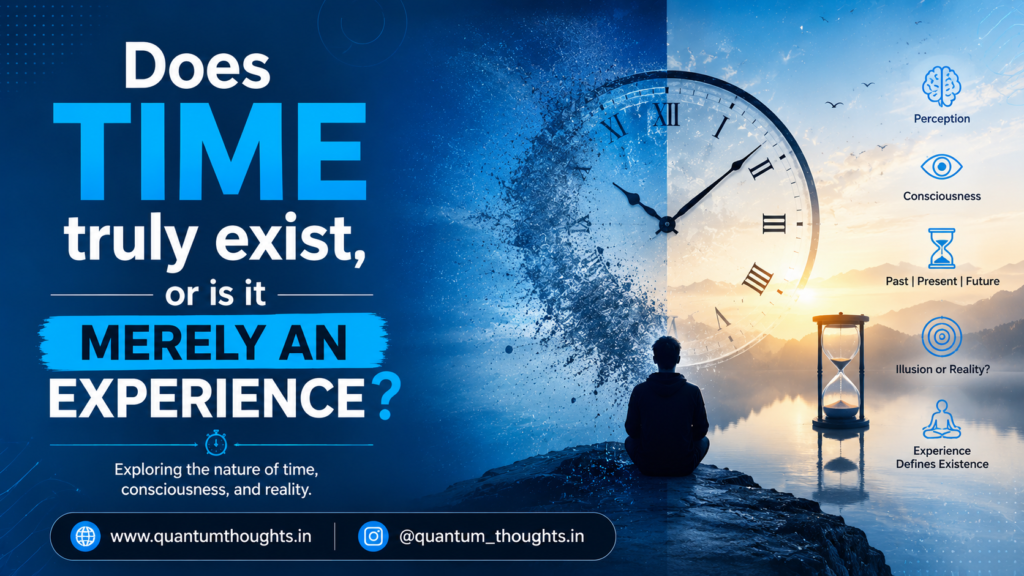
Perhaps time is not something we move through. Perhaps it is something we experience.
The sun rises in the moring and sets in the evening. The hands of the clock constantly move forward. We celebrate birthdays, age increases, and years go by. Observing all this, it seems to us that time is something that is constantly moving forward.
But if someone were to ask you:
“Does time really exist, or is it merely a part of our experience?”
The answer to this question is not that simple.
Philosophy, physics, and psychology, all three view time differently. For some, time is fundamental dimension of the universe, while for others, it is a mental construct experienced by the mind.
Let us try to understand what we actually know about time.
What is time?
In daily life, the meaning of time seems very simple.
One minute follows another.
One day follows another.
But in science, time is not just the hands of a clock.
Time is the system through which we understand the sequence of events, what happened latter, and the interval between two events.
A clock does not create time.
It’s just a tool to measure time.
Is time always flowing at the same rate?
For many years people thought that time passes at the same rate everywhere in the universe.
But in 1905 Albert Einstein, in his special theory of relativity, showed that time does not pass at the same rate for everyone.
If someone is travelling at near light speeds, then time may be going slower for that person. If someone is travelling at near light speeds, then time may be going slower for that person.
This phenomenon is know as time dialation.
This is not merely a theoretical concept,this effect has been measured through experiments involving ultra precise atomic clocks and satellites.
Thus time is not an absolute and fixed entity.
Gravity bends time as well.
According to Einstein’s general relativity, time passes slightly more slowly in regions with stronger gravity.
For example, time passes slightly more slowly on Earth’s surface compared to satellites.
If this effect is not accunted for in technologies like GPS, significant errors in location can occur.
This demonstrates that time is not merely a metter of perception it can physically change as well.
So, Does time actually exist?
From the perspective of physics, time is a part of the universe’s four dimensional structure known as space-time.
Therefore, science does not regard time as merely a figment of the imagination.
But an interesting question arises here.
If time exists, why do we always perceive it as moving only forward?
Why does time move only forward?
Even science does not yet have a complete answer to this question.
However, there is a significant concept : Entropy
According to thermodynamics, disorder(entropy) generally increases in a closed system.
A broken cup does not put itself back together.
Hot tea cools down, but cold tea does not heat up on its own.
For this reason, we perceive time moving forward in one direction.
This is often referred to as the “Arrow of Time.”
Why does psychology say?
Psychology views time somewhat differently.
We do not always experience time in the same way.
Consider this :
- Two hours spent happily seem to fly by in moments.
- When we are waiting, even five minutes feel long.
If the time is the same, why does the experience of it change?
Because our brain constructs the experience of time based on circumstances, attention, and emotions.
Therefore, clock time and mental time are not always the same.
Are the past, present, and future truly different?
We divide life into three parts:
- Past
- Present
- Future
However, some physicists and philosophers believe that this division might be part of our experience.
According to some interpretations of Einstein’s theory of relativity, the entirety of space-time is envisioned as a whole, a concept sometimes referred to as the “Block Universe.”
Under this view, the “present” is not necessarily the same for everyone.
This remains a subject of ongoing debate and research.
Is time merely a constuct of the mind?
Some schools of philosophy claim that our experience of time is a construct of our minds.
Time we know in our memories of the past and in our dreams of the future.
But when we are so absorbed in the present moment, such as when we are meditating or doing a creative activity, our sense of time tends to slow down or almost disappear.
Therefore, some people argue that the experience of time and the physical existence of time could be two different things.
Time and Life
We often say:
I don’t have time.
But perhaps the real question is:
“Where do I focus my time?”
Because we cannot stop time.
But how we use it is in our hands.
The value of time does not lie in its speed.
It lies in how we live it,
Can life be imagined without time?
If there were no time, then:
- There would be no change.
- There would be no growth.
- There would be no memories.
- There would be no imagining the future.
Time is not merely a measurement on a clock.
It is a framework that gives meaning to experience, change, and life itself.
Thus, even through the experience of time is mental, it impacts every aspect of our lives.








Add comment