

 Ravi Dangariya
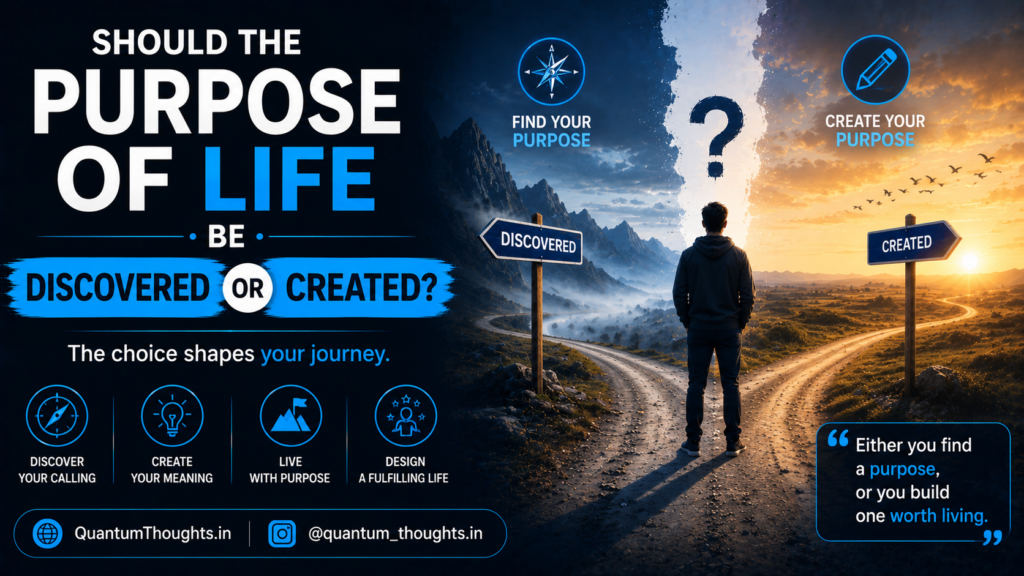
“Perhaps the purpose of life is not waiting to be found. Perhaps it is waiting to be created.”
When we are young, people often ask us a question:
“What do you want to be when you grow up?”
But there comes a time in life when the question changes:
“Why am I doing all this?”
“What is the purpose of my life?”
This is perhaps humanity’s oldest and deepest question.
Some people believe that everyone is born for a specific purpose.
However, some philosophers argue that there is no pre-determined purpose in life.
We create the meaning ourselves.
So what’s the truth?
Is the meaning of life already out there somewhere, waiting to be discovered?
Or is it what we choose and do that gives life its meaning?
The Idea: Finding a Purpose
In many religions and spiritual traditions, people believe that everyone has a purpose in life.
Some people feel they possess a unique talent.
Others feel they were born to do something special for society.
This idea gives people hope.
It provides direction in life.
However, there is a challenge associated with it.
What if one does not find their purpose even after years?
Many people spend their entire lives trying to discover, “What is my true purpose?”
What if a purpose isn’t predetermined?
According to Existentialism—a significant philosophical school of thought—there is no pre-existing meaning to life.
We create that meaning ourselves.
This idea can seem a bit daunting.
Because the responsibility now rests entirely on us.
Yet, this same idea is also deeply liberating.
If a purpose isn’t already set, it means we can give meaning to our lives through our own values, choices, and actions.
Does everyone have the same purpose?
Perhaps not.
A teacher’s purpose might be to inspire students.
A doctor’s purpose might be to serve patients.
An artist’s purpose might be to express emotions.
A mother or father’s purpose might be to build a good future for their children.
And someone’s purpose might simply be to become a slightly better human being each day.
The purpose can be different for everyone.
Can purpose change over time?
Yes.
We often think that there is only one purpose in life.
But the truth is purpose can change.
What seems important at the age of twenty may not seem as much at the age of forty.
Our priorities shift at every stage of life.
And along with that, the meaning of life can also change.
This change is natural.
What does psychology say?
Psychology tells us that people who have a sense of meaning and purpose in life are more likely to be happy and mentally well.
Having a purpose doesn’t mean you need to do something big.
It means feeling like what you do makes a difference.
This sense of meaning can also be found in little things.
Something like:
- Helping somebody.
- Spending time with family.
- Learning something new.
- Engaging in creative work.
Why might it be better to create a purpose rather than search for one?
Imagine standing before a blank canvas.
If you spend your entire life wondering what image *should* already be on that canvas, you might never actually start painting.
But if you pick up a brush and begin to paint, a beautiful picture may gradually emerge.
Life is perhaps much the same.
Purpose is often found not by thinking, but by living.
A simple example
Suppose a student says:
“I don’t know what my life’s purpose is, so I’m not starting anything.”
Another student says:
“I will learn new things, work with people, and gain experience. Perhaps my path will become clear through that.”
Years later, the second student often finds a much clearer direction for their life.
This is because, instead of waiting for the answer, they embarked on the journey.
Can even a small purpose be significant?
Yes.
We often think that one’s purpose in life must be something extraordinary.
But not every purpose needs to be grand.
Someone might enjoy bringing a smile to a person’s face every day.
Someone might love teaching children.
Someone might enjoy writing inspiring thoughts.
All of this, too, can be part of a meaningful life.
Where is the meaning of life found?
Perhaps the meaning of life is not found in any single place.
It lies in our relationships.
In our curiosity.
In learning from our mistakes.
In our creativity.
And most important…
It is found in the values on which we base our lives.







Add comment