

 Ravi Dangariya
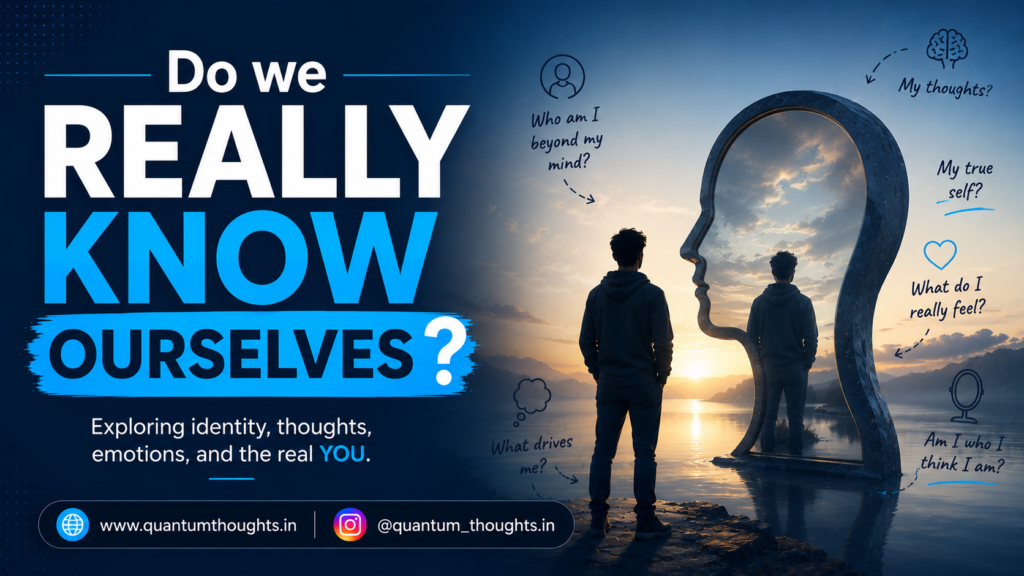
The greatest mystery is not the universe around us, but the self we assume we already know.
Every day, we see our own face in the mirror, we know our name, our profession, and even our likes and dislikes. Therefore, we feel that we know ourselves well.
But if someone asks you just one question:
“Who are you, really?”
So, can you answer that easily?
Are you your name?
Are you your profession?
Are you your thoughts?
Are you your memories?
Or are you something more than all of this?
This question is not merely one of philosophy. Psychology, neuroscience, and spiritual traditions also attempt to understand this question from this respective perspectives.
Are identity and true self one and the same?
We often mistake our identity for our very existence.
For example :
I am a doctor.
I am an engineer.
I am a successful person.
I am an unsuccessfull person.
But all of this is information about us.
It is not us.
If your job changes tomorrow, do you change?
If you move to another country, does your very existence change?
This question suggests that identity and the true self are perhaps difference things.
How do we know ourselves?
Our understanding of ourselves is formed from many sources.
- What our family tells us.
- How society views us.
- Our experiences.
- Success and failure.
- The response of others.
Gradually, we piece all of this together to create a story.
“This is who I am.”
But is this story the whole truth?
Or is it merely a defination of our life?
The brain creates stories
Modern neuroscience suggests that our brain constantly tries to make sense of experiences.
Sometimes we make a decision, and then the brain finds a reason for it.
Thus, we feel that we are fully aware of every choice we make.
However, in reality, many of our decisions are also influenced by emotions, habits, and subconscious processes.
This does not mean that we do not know ourselves at all.
This means that one’s own understanding is not always complete.
Are we merely our thoughts?
Thousands of thoughts cross the mind every day.
Some positive.
Some negative.
Some are useful.
And some are completely pointless.
If we were every single thought, our existence would keep changing every minute.
But there is something that knows about every thoughts.
When you say:
“Many thoughts are running through my mind today.”
So we are more than our thoughts.
Do we understand our own emotions?
We often say:
“I got angry.”
But if we look a little deeper, perhaps there was fear behind that anger.
Or sadness.
Or the experience of rejection.
Often, we cannot even grasp the true reason behind our own emotions.
Therefore, self-awareness is not merely about understanding thoughts.
It is also about understanding emotions.
How much time do we spend with ourselves?
In today’s times, we are constantly busy.
Mobile phones.
Social media.
Work.
Entertainment.
A conversation.
But there is a question:
When was the last time you spent some time alone with yourself, without any interruptions?
When we remain constantly occupied with the outside world, we get fewer opportunities to discover our inner world.
What is self-awareness?
Self-awareness does not mean finding the answer to every question.
It means being aware of what is going on inside oneself.
For instance :
What am I feeling right now?
Why am I thinking this way?
What could be the reason behind my reaction?
Am I seeing reality, or merely my own beliefs?
Such questions can mark the beginning of self-awareness.
Can self-awareness change your life?
Many studies suggest that people with greater self-awareness:
- Can make better decisions.
- Can understand their emotions better.
- Can be more effective in relationships.
- Can learn from their mistake.
Self-awareness does not mean being perfect.
It means constantly learning.
What can be done to know yourself?
1.Ask yourself questions.
Take some time out every day to ask:
- What did I learn today?
- What was I most influenced by today?
- Why do I believe what I believe?
2..Write down your thoughts.
Writing a diary often reveals patterns of the mind.
Thoughts that seem tangled in the mind become clearly visible on paper.
3. Observe your thoughts.
Instead of accepting every thought as the truth, practice viewing it merely as a thought.
This habit helps us create some distance from our own beliefs.
4. Accept feedback
Sometimes, others can see things about us that we ourselves cannot see.
Not every criticism is valid.
However, it is not right to immediately dismiss every piece of feedback either.
5. Gain new experiences
Visiting new places.
Meeting new people.
Learning something new.
All of this gives us a new understanding of both our limitations and our strengths.
Will we ever be able to fully ourselves?
Perhaps not.
Because we are constantly changing.
Our thoughts change.
Our beliefs change.
Experience change.
With every new experience, we too change a little.
That is perhaps why self-realization is not a final destination.
It is a continuous process.







Add comment