

 Ravi Dangariya
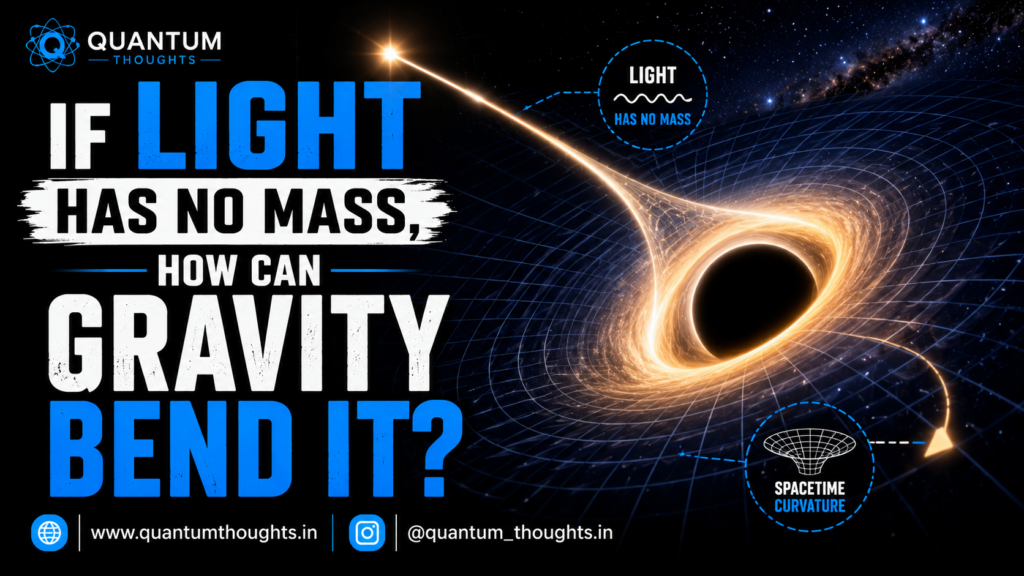
“Gravity does not pull light because light has no mass. It bends light because it bends the fabric which light travels.”
This is the one of the most interesting question in physics.
We learn in school that gravity pulls objects with mass towards each other. Natually, the question arises:
“If light has no mass, then how can the gravity of the Sun, Planets, or Black holes bend light ?”
This question is fascinating because it takes us beyond Newton’s gravity to Albert Einstein’s General Theory of Relativity.
In this article, we will try to understand in simple language why light bends and why this phenomenon revolutionized the world of physics,
Does light really have no mass ?
Yes.
Light is made of tiny particles called Photons.
The rest mass of photon is zero.
So, why we say that light has no mass, it means that a photon possesses no mass when at rest.
Nevertheless, light possesses energy and mementum.
Therefore, light can interact with other objects, but its deflection by gravity is not due to this alone.
Why does Newton’s theory of gravity state?
According to Newton’s theory, gravity is the attraction between two objects possessing mass.
This concept allows for a very good explanation of the motion of the Earth, the Moon, and the Planets.
However, a problem arises here.
If gravity act only on objects possession mass, then why does it affect light?
A complete answer to this question is not found in Newton’s theory.
Einsteing changed the way we think.
In 1915, Albert Einstein presented the General Theory of Relativity.
He started that Gravity is not an invisible force that pulls objects.
Instead, mass and energy curve space-time.
Then everything, planets satellites, and even light- follows the straightest possible path through this curved space-time.
This is where the entire understanding changes.
What is space-time?
We generally consider space and time to be saperate things.
However, according to Einstein, together they form a four-dimentional framework known as space-time.
Imagine a stretched rubber sheet.
If a heavy ball is placed on it, the sheet will curve downwords.
Now, if you roll a small glass marble near it, it will move along a curved path instead of travelling in a straight line.
This example is not complete, but it helps in understanding the basic idea.
Similarly, massive objects like the Sun warp space-time.
Why does light bend?
Here is the most important point to understand.
Gravity does not pull light with a rope.
It curves the very path along which the light travels.
Light always follows the straightest path available in space-time.
But, when space-time itself is curved, the path of light also appears curved.
So, it seems as through gravity pulled the light,
In reality, the light simply followed the path of the curved space-time.
The historic solar eclipse of 1919
Einstein’s theory was not merely an idea.
It was also put to the test.
In 1919, astronomer Arthur Eddington observed the positions of stars appearing near the Sun during a total solar eclipse.
It was found that the light from the stars bent slightly as it passed near the Sun.
This obesrvaion matched Einstein’s prediction.
After this event, General Relativity becomes famous wordwide.
What is Gravitational Lensing?
Gravitational lensing is when the light from stars or galaxies behind a massive celestial object such as a black hole is bent.
In this phenomenon light from a distant galaxy is bent and reaches the Earth.
Sometimes, multiple images of the same galaxy appear.
At times , the light appears in a circlular shape, known as an Einstein Ring.
This phenomenon is highly significant in the study of the universe today.
Why do black holes not let light escape?
Many people think that black holes “pull in” light.
In reality, space-time around a black hole is so severely curved that, beyond a certain boundry, there is not way for light to escape.
This boundary is called the Event Horizon, or Event Horizon.
Once light has crossed this boundary it cannot get out.
That is why black holes look dark to us.
Does gravity affect light?
Yes but not in the usual way.
Light has no mass . It is affected by gravity because gravity changes the geometry of space-time .
Light travels througth that altered geometry.
This is the reason why we can see the light of stars passing close to the Sun being bent.
Common Misconceptions
Misconception 1 : The Sun pulls light like a rope.
Truth : The Sun Curves space-time.
Misconception 2 : Light has mass, so it bends.
Truth : Photons have no rest mass.
Misconception 3 : Light itself changes direction.
Truth : The path of spacetime changes, and light follows that path.
What is the significance of this discovery?
If Einstein’s theory were not correct, we would not have been able to learn many important things about the universe today.
It is based on this theory that :
- The study of black holes become possible.
- Distant galaxies could be discovered through gravitational lensing.
- Necessary improvements in modern technologies like GPS become possible.
- The path to the discovery of gravitational waves was opened.
A simple question provided a new way to understand the entire universe.







Add comment