

 Ravi Dangariya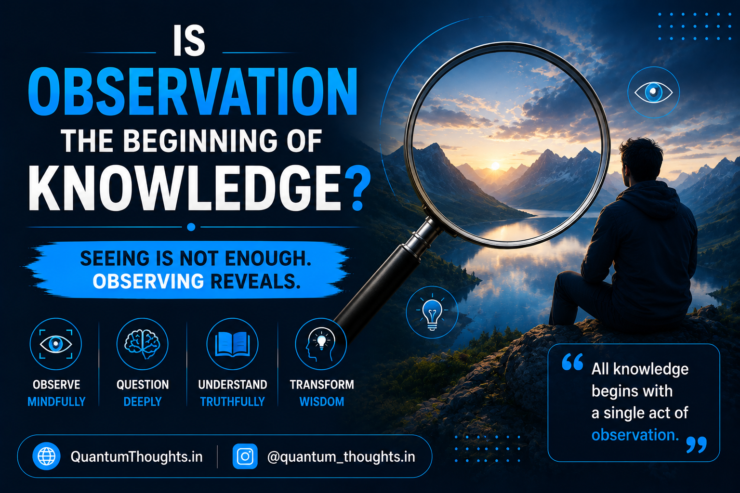
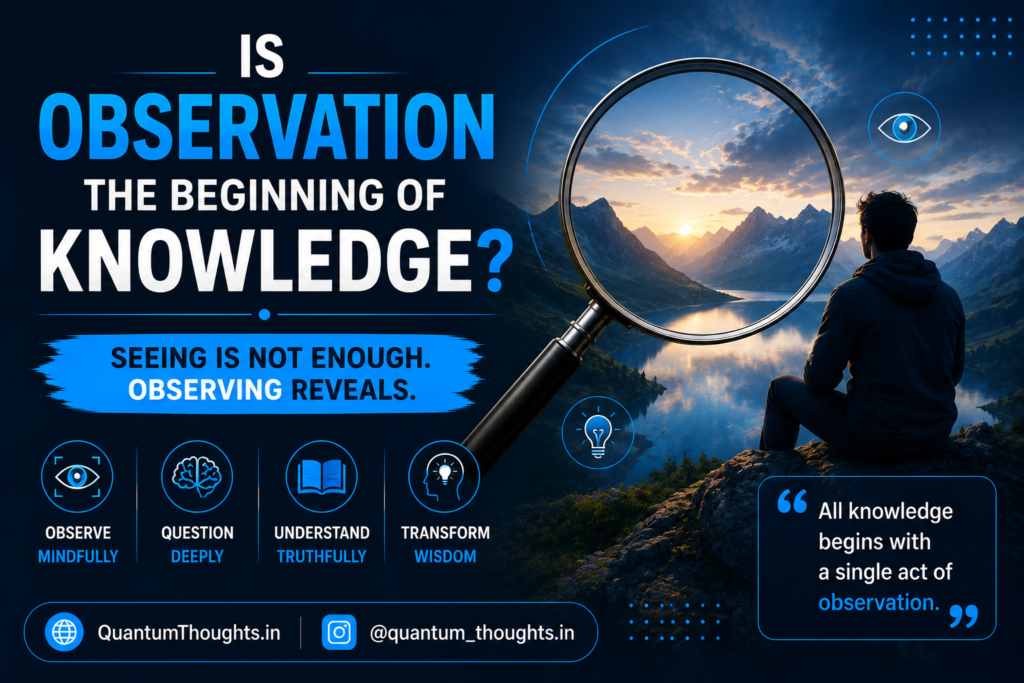
“Before we can understand the world, we must first learn to truly observe it.”
We see thousands of things every day.
People, trees, the sky, roads, faces, and countless events.
But does seeing something necessarily mean understanding it?
The answer is no.
‘Seeing’ and ‘observing’ are two different things.
Seeing is merely the process of gathering information through the eyes.
Watching on the other hand is looking carefully, curiously and with a desire to understand.
That is precisely why many philosophers and scientists believe knowledge begins with observation.
What is an observation?
Observation is not just to look at something.
This means looking closely at something, asking questions about it and trying to see the patterns in the way it behaves.
A person might, for example, see the sun rise every day.
But an astronomer, looking at that same sunrise, reflects on the movement of the Earth.
The event is the same.
But the observation is different.
How does knowledge begin?
Every discovery starts with a question.
And every good question stems from an observation.
When Isaac Newton saw an apple fall, the falling of an apple was not a new phenomenon.
Millions of people had seen apples fall before that.
But Newton asked a question:
“Why do things always fall downwards?”
Ideas about gravity developed from this question.
What matters is not that he saw the apple.
What matters is that he observed it.
The Difference Between Seeing and Observing
Suppose you travel to the office via the same route every day.
One day, someone asks how many trees are along the way.
It is possible that you do not know the answer.
You had passed by there every day.
But you had not observed carefully.
This shows that our brain often does not register information, even when we see it.
Eyes alone are not enough for observation.
Attention is also necessary.
The Importance of Observation in Science
Science often begins with observation.
Scientists first observe a phenomenon carefully.
Then, they ask a question.
Next, they formulate a hypothesis.
Then, they conduct experiments.
And finally, they reach a conclusion based on evidence.
If proper observation does not take place at the beginning, the entire process can go in the wrong direction.
Is observation always accurate?
No.
Our senses are not perfect.
Sometimes, optical illusions mislead us.
At times, our brain fills in the gaps in incomplete information.
That is why, in science, we do not rely on the observation of just one person.
It is verified repeatedly.
It is replicated by others.
And it is compared against evidence.
What does philosophy say?
In philosophy, too, great importance is placed on observation.
However, philosophy does not merely observe the external world.
It also observes one’s own mind.
For example:
- Why do I believe what I believe?
- Where do my thoughts come from?
- Are my beliefs correct?
Questions of this nature lead to self-observation.
And often, true understanding begins there.
Observation in Psychology
Psychology shows that we often live on autopilot.
We do not observe our own emotions, thoughts, and habits.
As a result, we repeat the same mistakes over and over again.
If a person takes some time each day to observe their thoughts and reactions, they can gain a better understanding of many of their habits.
This is precisely why observation is emphasized in practices like mindfulness.
A simple example
Suppose two students fail an exam.
One student immediately says:
“I will never succeed.”
The other student takes some time to reflect:
- Where did I go wrong?
- Did I study enough?
- What can I improve for the future?
Both faced the same outcome.
But the second student reflected on it.
And that very reflection gives him an opportunity to learn.
Is observation alone sufficient?
No.
Observation is the starting point.
But then it requires thought, analysis and evidence.
If we simply accept everything we see as true, we could fall prey to illusion.
True knowledge arises only when logic and evidence are combined with observation.
How can we become good observers?
A few simple habits can help in becoming a good observer.
- Avoid jumping to conclusions.
- Ask more questions.
- Examine one’s own beliefs.
- Pay attention to details.
- Be willing to change one’s opinion upon receiving new information.
These habits enhance not only knowledge but also understanding.







Add comment