

 Ravi Dangariya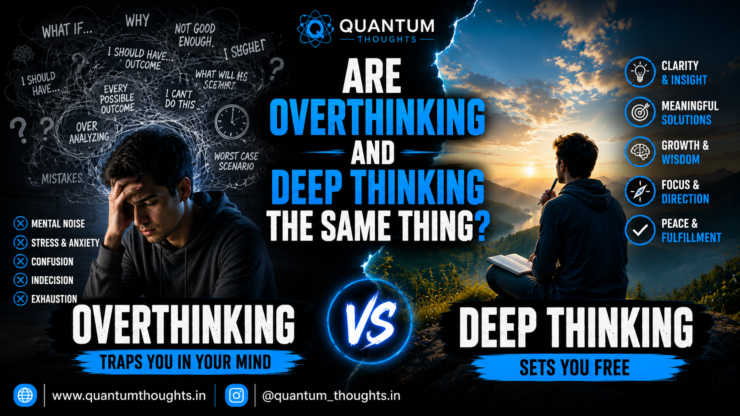
Depth of thought brings clarity. Repetition of thought brings confusion.
Many people belive that are thinking deeply, but in reality, they are overthinking. Conversely, some people mistake deep thinking for overthinking.
The two terms seem similar because both involve, “Thinking,” but from a psychological perspective, there is a significant difference between them.
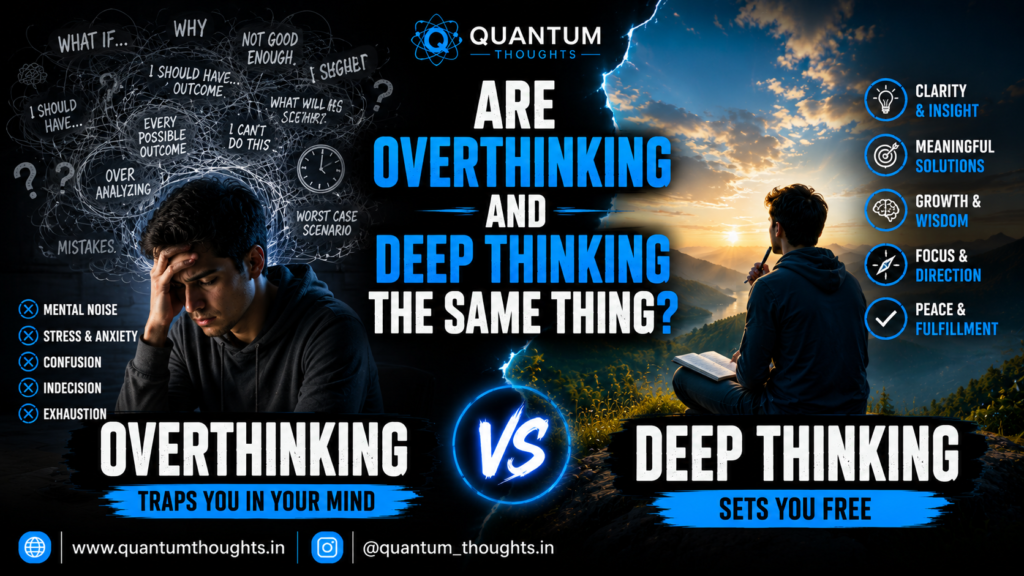
Deep thinking leads to new insights, better decisions, and creative ideas, whereas overthinking often results in axiety , confusion and mental fatigue.
So the question is are overthinking and deep thinking the same thing ?
The answer is No.
Let us understand the difference between two,
What is deep thinking?
Deep thinking means trying to understand a subject calmly, with curiosity and from various perspectives.
Purpose of this type of thinking is to discover the truth or find a solution to a problem.
For example :
- “Why do people think differently.”
- “What is the basis of this belief of mine.”
- “What could be the most appropriate solution of this problem.”
Such questions lead us towards greater clarity.
After deep thinking, the mind ofter feel lighter because we gain new understanding.
What is overthinking ?
In overthinking, we repeatedly dwell one the same subject, but this process involves less new insight and more anxiety.
For example :
- “Why did I say that?”
- “What must people be thinking about me?”
- “What if this happens?”
- “What if I made the wrong decision?”
Such thoughts often go round and round in circles.
They do not lead to any solution
They only increase mental fatigue,
The biggest difference between two
The aim of deep thinking is to undertand.
The aim of overthinking is often to avoid uncertainity.
One stems for curiosity.
The other stems for fear.
A simple example :
Suppose you gave important presentation.
Deep thinking :
You reflect :
- What went well?
- Where can I Improve?
- How can I prepare better next time?
After some time, you reach a conclusion.
The thought process concludes.
Overthinking :
Now, consider another situation.
You keep thinking :
- “Maybe everyone is making fun of me.”
- “I said one wrong word.”
- “People must think I am incompetent now.”
- “If only I could change that moment.”
These thoughts persist for hours and or even days.
They offer no solution.
Why do overthinking happen?
Often, the main reason behind overthinking is uncertainty.
The brain seeks a definite answer to every questions.
However, many questions in life do not have clear answers.
When we can not accept uncertainty, the brain gets trapped in the same thoughts repeatedly.
In psychology, this process also known as rumination.
Deep thinking enhances creativity
Science, philosophy, and art all of these have evolved through deep thinking.
Issac Newton, Albert Einstein, and many other great thinkers pondered deeply over complex quesions.
Their aim was not to increase their anxiety.
Their aim was to understand.
Deep thinking leads us toward new ideas, new discoveries and new understanding.
Overthinking makes decision making difficult
Many people take long time even to make small decisions.
This is because they keep thinking about every possible outcome.
- What if this turns out wrong?
- What if the other option is better?
- What if people judge me?
As a result, they delay making a decision or fail to make one altogather.
This is often referrend to as “Analysis Paralysis.”
How do you distinguish between deepthinking and overthinking?
Ask yourself these questions :
- Am I exploring new perspectives?
- Or am I repeating the same thoughts over and over?
- Are my thoughts leading me toward a solution?
- Or are they merely increasing my anxiety?
- Do I gain clarity after thinking?
- Or do I feel more confused?
If you gain clarity after thinking, it might be deep thinking.
If thinking leads only to exhaustion and increased anxiety, it is likey overthinking.
How do you break free from overthinking?
First, it is essential to accept that it is not possible to find a perfect answer to every question.
Then, ask yourself :
- Is this thought within my control?
- Is there anything I can do right now?
- If not, will dwelling on it change the situation?
Often, simply asking these questions can break the cycle of overthinking.
How do develop deep thinking?
If you want to develop the ability to think deeply :
- Be curious
- Ask good questions.
- Read diverse perspectives.
- Do not rush to find an immediate asnwer.
- Challenge your own thoughts as well.
The goal of deep thinking is not to prove the correct answer.
Its goal to gain a better understainding.
Why is balance neccessary?
Thinking is essential.
But not every thought is useful.
If we stop thinking altogether, progress will come to a halt.
And if we keep thinking incessantly, we will lose our peace of mind.
Intelligence does not lie merely in thinking more.
It lies in both knowing when to start thinking and when to stop.









Add comment