

 Ravi Dangariya
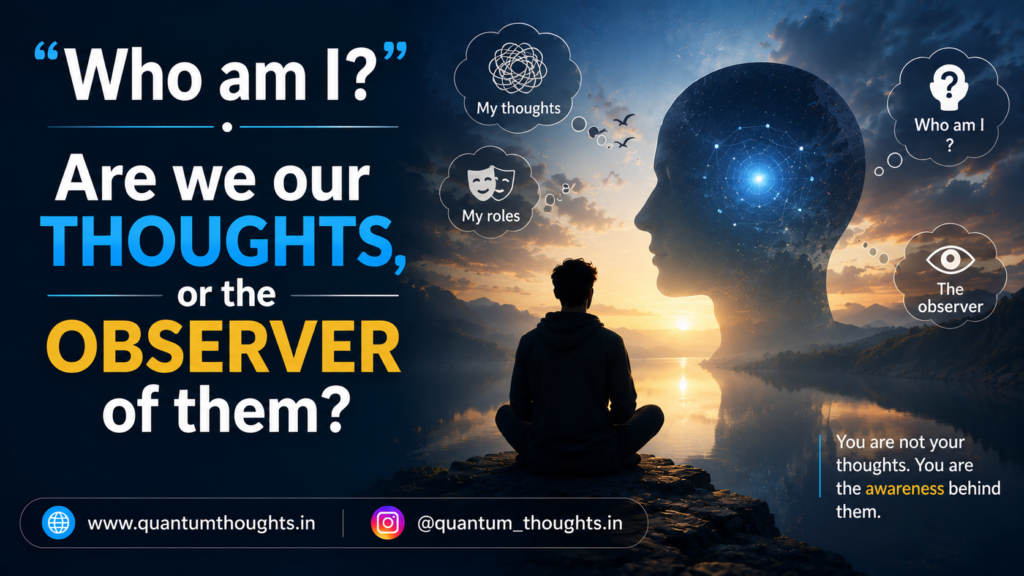
The greatest question is not what you think, but who is aware that you are thinking.
Throughout human history, a question has been asked repeatedly for thousands of years:
“Who am I”
This question seems so simple that it can be answered immediately. We say, “I am a teacher,” “I am an engineer,” “I am a mother,” “I am a student”
However, if we reflect a little more deeply, we realize that all these answers are merely our identity, not who we truly are.
If your job were to change tomorrow, would you change?
If a part of your memory were lost, would you cease to exist?
If all of your thoughts were to change, would “you” change as well?
This questions leads us into the deepest realms of philosophy, pyschology, and the study of consciousness.
How do we build our own identity?
After birth, we gradually begin to build our own identity.
We acquire a name.
Then, family, language, religion, culture, education, and experiences begin to shape our personality.
Gradually, we come to believe that :
- I am my thoughts.
- I am my memories.
- I am my successes.
- I am my failures.
But is all this truly “me”?
Or is it all merely a part of our experience?
Are we our thoughts?
Thousands of thoughts cross our mind throughout the day.
Some thoughts bring joy.
Some cause anxiety.
Some thoughts are useful.
And some thoughts have no meaning at all.
If you were merely your thoughts, then a question arises:
When you say, “Many thoughts are running through my mind,” who is saying this?
If there is someone who observes the thoughts, then how can the thoughts and the observer be one and the same?
Thoughts and the Observer
Imagine you are watching clouds floating in the sky.
The clouds are constantly changing.
Sometimes white.
Sometimes black.
Sometimes they bring rain.
But the sky does not change.
Many philosophers and meditation traditions say that:
Thoughts are like clouds.
And
Awereness is like the sky.
Thoughts arises.
They linger for a while.
Then they pass away.
But the ability to observe them remains constant.
What does psychology say?
Modern psychology also shows that it is not necessary to believe every thought.
Often, our thoughts :
- Are influenced by fear.
- Are shaped by past experiences,
- Are based on false assumptions.
- Or are simply part of the mind’s autimatic processes.
If every thought were always correct, people would never realized their mistakes.
Therefore, there is not always a correspondence between thought and truth
If we are not our thoughts, then who are we?
There is no single scientific or philosophical answer to this question.
However, an interesting observation can be made.
The eyes can see.
The ears can hear.
The mind can think.
But who is it that experiences all this?
When you feel sorrow, you realize, “I am experiencing sorrow.”
When you feel joy, you become aware of that as well.
This very “capacity to know” is, for many thinkers, the basis of consciousness.
Can one learn to observe thoughts?
Yes.
When we sit quietly for a while and try to simply observe the thoughts arising in our minds, an intresting experience can occur,
Thoughts keep changing constantly.
A thought arises.
Then another.
Then a third.
If you do not try to stop them, but simply observe, you realize that thoughts can come and go on their own.
This experience shows us that it is not necessary to attach one’s identity to every thought.
Does this mean that thoughts are not important?
No.
Thougths are very important.
Through them, we learn, solve problems, and engage in creative work.
But the problem arises when we accept every thought as the abosolute truth.
For example:
“I am a failure.”
This can be a thought.
But it does not necessarily have to be a fact.
If we understand the difference between thought and reality, mental peace increase.
Can one’s identity change?
Yes.
Our thoughts change.
Beliefs change.
Like and dislikes change.
Personality, too, can change over time.
If all this changes, then perhaps “I” am not merely a collection of these changing things.
Perhaps “I” am the one who experiences all these changes.
A dialogue between philosophy and science
Philosophy asks:
“Who am I ?”
Neuroscience asks:
“How does consciousness arise in the brain?”
Meditation asks:
“Can you simply observe your own thoughts?”
All three questions are different.
But the focal point of all three is the same, human experience.
To this day, no universally agreed upon answer has been found.
And perhaps that is precisely what makes this question ever more interesting.
What does this mean for daily life?
If we understand that not every thought defines our identity, then
- Critisism would affect us less.
- We could view negative thoughts from a distance.
- We could try to understand our emotions instead of suppresing them.
- Our relationship with ourselves could become healthier.
This does not mean rejecting thoughts.
It means giving thoughts their proper place.
“You are not the thoughts that pass through your mind. You are the silent presence that notices every one of them.”
-Ravi Dangariya (Rick Patel)








Add comment