

 Ravi Dangariya
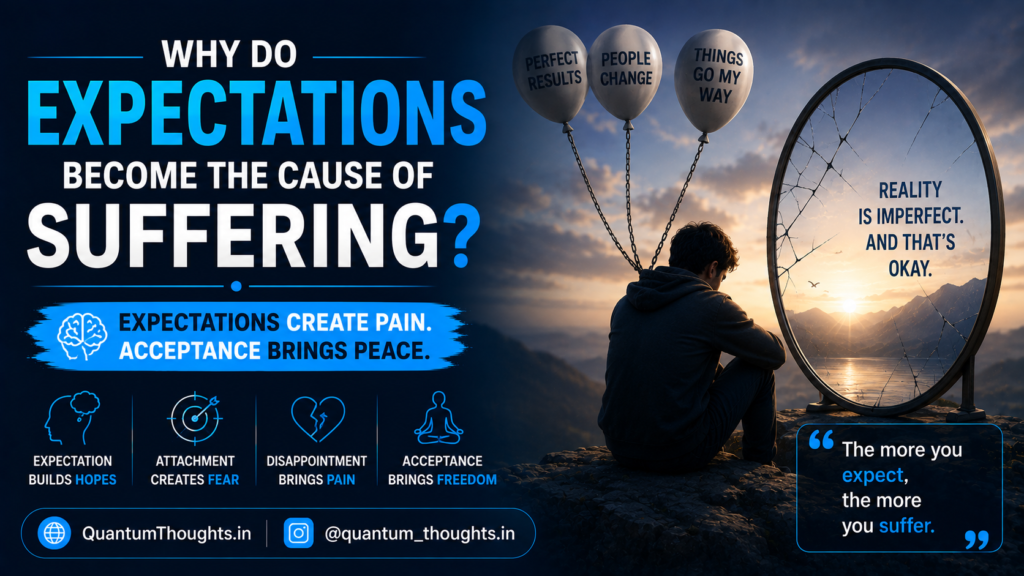
“Suffering often begins not with reality, but with the distance between reality and our expectations.”
We all harbor certain expectations in life.
It is natural to have expectations.
We want people to understand us.
We want our hard work to yield good results.
We want relationships to last.
And we want life to unfold according to our plans.
However, life often does not turn out that way.
And that is when suffering arises.
The question is: is the cause of suffering truly the situation, or is it our expectations?
Philosophy, psychology, and spiritual traditions have long contemplated this question.
What is an expectation?
An expectation is a mental image we form about the future.
We pre-determine how a person will behave, how an event will unfold, or how life ought to be.
The problem arises when reality does not align with this mental image.
In other words,
An expectation is about “what should happen.”
Whereas reality is “what actually happened.”
The greater the gap between the two, the higher the likelihood of disappointment.
A simple example:
Suppose you send a long birthday message to your friend.
Deep down, you expect that when your birthday arrives, they will do the same.
But when your birthday comes, they simply write a short “Happy Birthday.”
Now, the question is:
Were you hurt just because of that message?
Or was it due to the gap between your expectation and reality?
Often, hurt stems more from the expectations we build around an event than from the event itself.
What does psychology say?
Psychology tells us that our brain is always predicting the future.
These predictions help us decide things.
But if these predictions keep being proven wrong, one might be disappointed, angry, or sad.
Therefore, having expectations is not bad in itself.
But rigid expectations often become a problem.
Is it wrong to have expectations?
No.
If a student works hard for an exam, it is natural to expect a good result.
If you give love in a relationship, it is also right to expect respect and trust.
The problem does not lie in having expectations.
The problem lies in the belief that “things must happen this way.”
Because life does not always go according to our plans.
Why do we form expectations?
Our brain does not like uncertainty.
It constructs a story about the future.
This story gives us a sense of security.
But life is not entirely predictable.
People change.
Circumstances change.
And sometimes, we ourselves change too.
What does philosophy teach?
Stoic philosophers believed that some things in life are within our control.
And some are not.
Our thoughts, decisions, and efforts are within our control.
But the thoughts of others, the weather, fate, or every outcome are not within our control.
When we become overly attached to matters beyond our control, suffering increases.
Expectations in Relationships
Most disagreements stem from expectations.
We often think:
“If they love me, they should understand me without me having to say it.”
But the other person cannot read our minds.
Many problems arise not from a lack of clear communication, but because of vague expectations.
Is it possible to live without expectations?
Not entirely.
As human beings, we think about the future.
We harbor hopes.
We make plans.
All of this is natural.
The question is not about eliminating expectations.
The Balance Between Expectation and Acceptance
Acceptance does not mean admitting defeat.
It means recognizing what we cannot change.
And striving for what we can change.
This balance brings us greater peace.
The question is whether we are willing to change ourselves when reality changes.
A small example:
Suppose you have planned a picnic, but it starts raining.
You have two options.
The first:
To stay angry all day about why it rained.
The second:
To change your plans and find a new way to adapt to the situation.
The rain is the same for both scenarios.
But the experience of distress can differ.
How to manage expectations?
Some simple habits can be helpful.
- Accept people as human beings, not as perfect individuals.
- Focus more on the effort than the result.
- Set expectations.
- Be open in your relationships.
- Make room for uncertainty in life.
These habits make expectations more realistic.








Add comment