
 Ravi Dangariya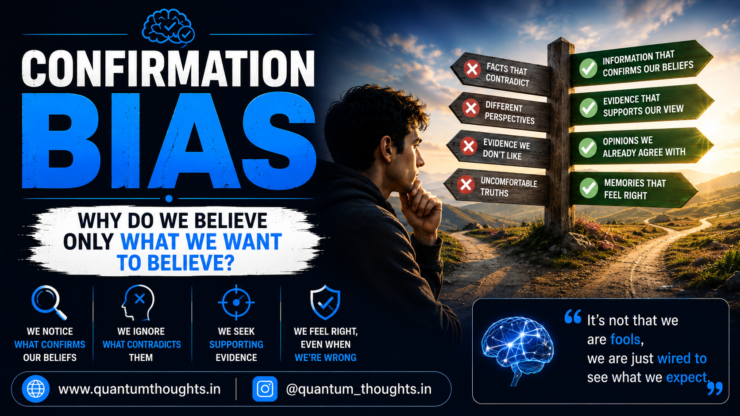
We do not always look for the truth. Sometimes we look for things that make us feel like our beliefs are true.
All of us think we are rational people.
We have reasons and evidence for believing something, and we believe it. But we are less objective thinkers than we are thinkers.
Sometimes we have an idea in our mind and then we look for evidence to prove it is true.
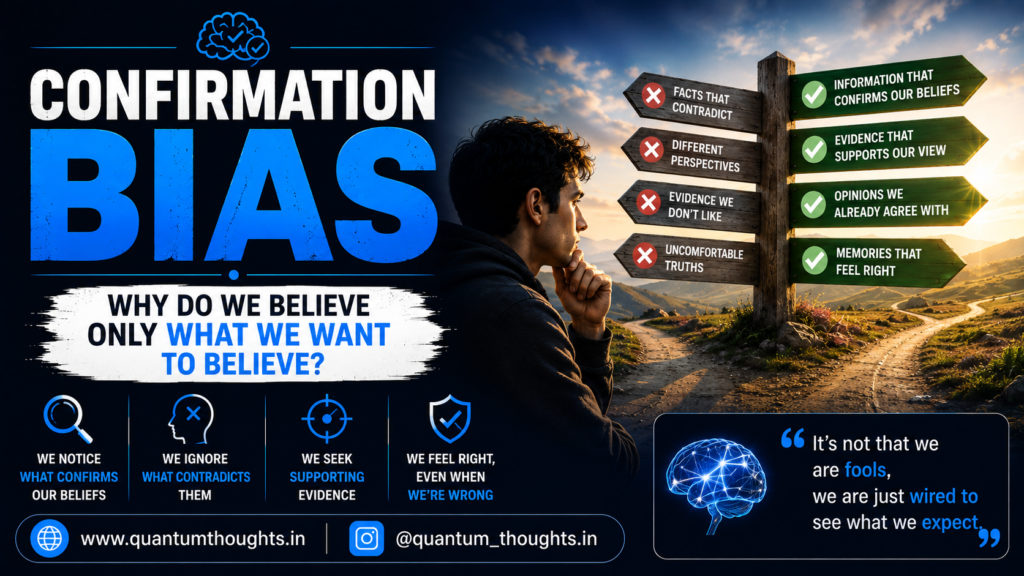
This mental inclination is called “Confirmation Bias”.
In layman’s terms:
We are inclined to look for, accept and retain data that confirms our pre-existing views, and we are more likely to overlook or dismiss data that runs counter to them.
What is Confirmation Bias?
Suppose someone believes:
I don’t trust people.
Now if someone treats them badly, they may immediately think:
‘You see, I was right. You can’t trust people.”
But if someone helps them, is honest or supports them in a hard time, they may not give so much importance to that event.
Here, the person is not looking at the evidence with impartiality.
Their brain is more attuned to information that is consistent with what they already believe.
This is Confirmation Bias.
Why do we do this?
Our brains are not there to do a perfectly impartial analysis of every piece of information.
The brain processes information to help us make decisions quickly.
It takes a lot of time and mental energy to think about each new piece of information from scratch.
So the brain often falls back on previous beliefs and heuristics.
If something seems to fit with what we believe, it feels easy to accept.
But if something challenges our beliefs, we tend to ask more questions.
A simple illustration
Let’s say you think “Social media is destroying people’s lives.”
Now you’re hearing some bad news about social media.
You say right away:
“You should have listened to me!”
But if you find research that shows social media is useful for some people. Like for social connection, or access to information.
The study is defective.
Here the two bits of information were not treated on an equal footing.
We tended to believe evidence that was consistent with our preexisting beliefs.
Politics and Confirmation Bias
Whenever it comes to political views the bias is evident.
If people like a particular party or leader, they are more likely to believe news that makes that party look good .
In contrast, they may easily believe negative information about the other party.
And when faced with negative information about their own party, they might say:
“This must be fake news.”
This issue is not limited to people holding a specific ideology.
Confirmation bias can be observed in almost everyone across various situations.
Social media can reinforce it.
In today’s world, social media can be a major factor contributing to confirmation bias.
Based on the content we choose, the posts we ‘like,’ and the accounts we follow, we continue to receive more information of a similar nature.
Consequently, our online environment can gradually become a reflection of our own views.
This phenomenon is often described as an “echo chamber.”
In such a situation, we tend to feel:
“Everyone thinks just like me.”
In reality, however, we are simply spending more time in a world populated by people who share similar views.
Confirmation bias exists in relationships too.
This bias is not limited to politics or science.
It can have a significant impact on relationships as well.
Suppose you believe that your friend does not value you.
One day, they reply late to your message.
You think:
“They don’t care about me at all.”
However, when they help you or show concern for you, you might simply dismiss it as an ordinary occurrence and move on.
In this way, our belief reinforces itself.
Love and Confirmation Bias
This can play out in interesting ways in love as well.
If we like someone, we tend to focus more on their positive qualities.
We might even justify their mistakes.
On the other hand, if we have formed a negative opinion about someone, even a minor mistake on their part can seem significant to us.
In essence, the person remains the same.
However, our interpretation of them can change based on our beliefs.
Is confirmation bias always bad?
It is not appropriate to label it as entirely “bad.”
One reason our brains have such biases is that they help us make quick decisions.
It is not practically possible to fully analyze every piece of information.
The problem arises when we are unaware of our own biases.
If we believe that “I am always unbiased,” we reduce the likelihood of recognizing our own biases.
How can we avoid confirmation bias?
The most important starting point is:
Questioning your own beliefs.
When something seems absolutely true to you, ask yourself:
“What if I am wrong?”
It is a simple question.
But it can shift your line of thinking.
Another question:
“What evidence contradicts my belief?”
This question can prevent us from seeking out only the information that supports our own views.
Try playing devil’s advocate.
When you hold a strong opinion on an issue, try arguing against it for a while.
For example:
“Why do I feel this decision is right?”
And then:
“If someone disagreed with me, what arguments would they make?”
This can help us discover the weak spots in our own thinking.
The courage to say “I don’t know”
is a powerful weapon against confirmation bias:
“Don’t know.
We often feel the need to have an immediate opinion about something.
But you don’t need to have the answer to every question at that moment.
Sometimes, true wisdom lies in being able to say:
“I don’t have enough evidence yet.”
This statement keeps us open to new information.
The Difference Between Truth and One’s Beliefs
The greatest challenge is that we often do not seek the truth; instead, we defend our own beliefs.
We want to be right.
But the truth is under no obligation to agree with us.
If new information proves our old belief wrong, changing that belief is not a defeat.
It is a capacity for learning.






Add comment