

 Ravi Dangariya
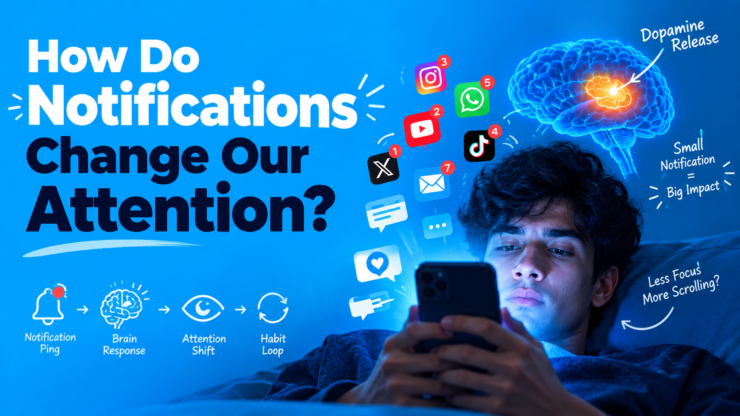
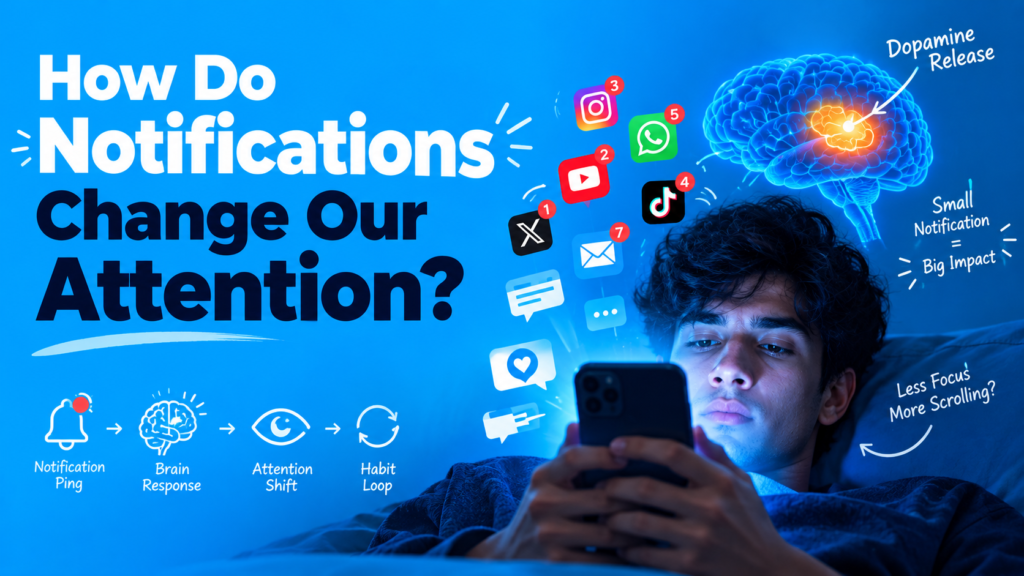
Every notification asks for a piece of your attention, even when you never asked for it.
You are engaged in an important task.
Suddenly, a notification appears on your phone.
A subtle sound.
A small pop-up on the screen.
And our attention is immediately drawn to the phone.
Sometimes, we even check the phone, even if the notification isn’t particularly important.
Then, we put the phone down and try to get back to work.
But here is the question:
Why can such a small notification shift our attention so quickly?
Our brain’s attention system, curiosity, and reward-related processes are major drivers of this.
What does attention mean?
Attention is the brain’s capacity to focus on something specific when there is a lot of information around.
We are bombarded with sounds, sights, thoughts, information.
However, we cannot pay attention to everything at once.
The brain has to decide:
“What is most important right now?”
This process of selection helps us with work, studies, and conversations.
However, notifications can suddenly interrupt this process.
A notification is an attention signal.
When a notification arrives on your phone, it doesn’t just provide information.
It sends a signal to our brain:
“There is something new here.”
It could be a new message.
A ‘like’.
An email.
A news update.
Or simply a reminder from an app.
It can spark curiosity in the brain—”What could it be?”
And this curiosity can pull our attention away from the task at hand.
Why does our brain consider every notification important?
Because we don’t know the content of the notification beforehand.
If we knew that every notification was just a routine update, we might simply ignore it.
But when we don’t know what’s inside, a sense of anticipation arises in our minds.
“Maybe it’s an important message.”
“Maybe someone has replied.”
“Maybe something interesting has come through.”
This sense of “maybe” can compel us to check our phones.
It is not easy to regain focus once attention is broken.
Suppose you are writing an article.
Your focus is entirely on the writing.
Suddenly, a notification arrives.
You look at your phone for just five seconds.
Then, you put the phone down.
You think to yourself:
“My attention wandered for only five seconds.”
But for the brain, that can be enough to require refocusing on the original train of thought.
What were you writing?
What were you going to write next?
Where did your train of thought leave off?
In this way, a minor interruption can break your mental flow.
Even after the notification, your mind might remain on the phone.
An interesting point is that even after putting the phone away, our mind may not fully return to the task at hand.
Sometimes, we keep wondering:
“Who might have sent a message?”
“Maybe a reply has come in.”
“Should I check again?”
Thus, the distraction isn’t limited to the time spent actually looking at the notification.
Sometimes, the mental effect can linger for a while.
Not all notifications are the same.
There is an important distinction here.
Not every notification is bad.
If you are waiting for an important call, a notification or the call itself might be truly necessary for you.
But when every app is vying for your attention, it can be difficult to distinguish between what’s important, and what’s simply noise.
“Therefore, it is important to distinguish between intentional and unnecessary notifications.”
Notifications can even change our habits.
Over time, a notification ceases to be merely an external signal.
We start checking the phone ourselves.
Sometimes, we unlock the screen even when there is no notification.
Is there a message?
Is there a ‘like’?
Is there a new story?
Is there an email?
In this way, an external notification can gradually transform into an internal habit.
Now, our brain no longer waits for a notification.
It begins seeking new information on its own.
Deep Work and constant notifications.
Deep work is the ability to focus without distraction on a cognitively demanding task.
The key to writing, studying, coding, research or creative work is sustained concentration.
Frequent notifications can repeatedly break one’s attention.
Therefore, minimizing notifications can be helpful when a long period of concentration is required.
Should we turn off notifications?
You don’t need to turn off all notifications.
But we can decide what notifications are really worth our attention.
For instance:
- Turn on notifications for important calls.
- Leturn on Notifications for important messages.
- Turn off unnecessary promotional notifications.
- Reduce social media alerts.
Use ‘Do Not Disturb’ mode while working or studying.
The goal here is not to run away from technology.
The goal is:
To decide who controls your attention.
Try a small experiment.
Try turning off unnecessary notifications for one hour today.
Then look at this:
Did you manage to work more peacefully?
Did you check your phone less frequently?
Was there less interruption to your train of thought while working?
This experience can provide you with useful knowledge to capture your attention.
Written by Ravi Dangariya(Rick Patel)
If you liked this article, please share your thoughts in the comments. 💭
In your opinion, do we control notifications, or do notifications control our attention?









Add comment