

 Ravi Dangariya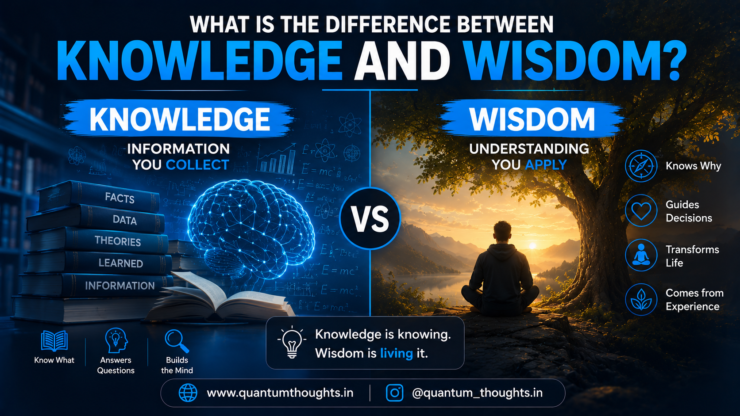
Knowledge fills the mind with information. Wisdom teaches the mind how to use it.
Present era is the age of information. Today, knowledge from across the globe becomes available on our mobile phones in mere seconds. We can read about any subject on the internet, access thousands of books, and watch countless videos.
However, there is an important question:
Is a person who possesses more information necessarily wiser?
The answer not always “Yes.”
Because knowledge and wisdom are not the same thing.
Many individuals possess a great deal of knowledge but lack the ability to make the right decision at the right time. On the other hand, some people make important life decisions very wisely, despite having very little formal education.
What then is the real difference between wisdom and knowledge?
What knowledge is?
Knowledge is the understanding that comes from data, information, facts, principles and experience.
For instance:
The Sun revolves around the Earth.
Water boils at 100 degrees celsius.
Exercise is necessary to keep the body healthy.
All this information is part of knowledge.
Knowledge helps us understand the world. It grows through learning, reading, listening and experience.
What is wisdom?
Wisdom is not merely knowing, it is the ability to apply that knowledge currectly at the right time.
If knowledge tells you that smoking is harmful to health, wisdom inspires you to refrain from it.
If knowledge tells you that decisions made in anger are often wrong, wisdom teaches you to remain silent when angry.
Wisdom develops through experience, introspection, and the lessons learned from life.
The main difference between knowledge and wisdom
Simply put:
Knowledge states “What is true.”
Wisdom asks “What is appropriate here and now.”
Knowledge provides information.
Wisdom provides direction.
Knowledge enriches the mind.
Wisdom enriches life.
Does more knowledge means more wisdom?
Not necessarily.
Today, many people know everything about health.
Yet, they do not get enough sleep, do not exercise regularly, or lead an unhealthy lifestyle.
Thus, having knowledge and living according to it are two different things.
Acquiring information is easy.
But putting it into practice is difficult.
From where does wisdom come?
You don’t learn wisdom from books.
It is often based on one’s life experiences.
Failure, relationships, mistakes, success, and self-reflection- all these combine to create wisdom.
What does psychology say?
According to psychology, information alone is not enough to make an intelligent decision.
For that, it is necessary to:
- Understand one’s own emotions.
- Consider long-term consequences.
- View the situation from different perspectives.
- Be willing to learn from one’s mistake.
All these qualities are part of wisdom.
Knowledge can breed arrogance, wisdom brings humility.
Often, a person with extensive knowledge feels they know everything.
However, a truly wise person realizes that there is still much that remains unknown.
As understanding grows, one’s own limitations also become increasingly apparent.
True wisdom begins not with “I know everything,” but with “I am still learning.”
A Difference in Daily Life
Suppose a disagreement arises between two people.
Knowledge might say:
“I am right”
Wisdom asks:
“Is this relationship more important that winning?”
Knowledge can win the agrument.
Wisdom can save the relationship.
The Balance Between Knowledge and Wisdom
Society needs both.
Progress is not possible without knowledge.
Progress can become dangerous without wisdom.
For example, creating technology is knowledge.
It is wise to use it well.
Discovering nuclear energy is knowledge.
Using it for human welfare is wisdom.
How can wisdom be cultivated?
Wisdom is not innate.
It develops gradually.
Certain habits can help in this regard:
- Learn something new everyday.
- Question your own beliefs.
- Learn from mistakes.
- Listen to people with different points of view.
- Think before you act. Stop and think.
- Take time for self reflection.
Wisdom does not mean knowing every answer.
It is about developing the ability to ask the right questions.
Can wisdom be learned?
Yes.
Every experience teaches us something.
But experience teaches us something.
But experience does not automatically turn into wisdom.
Wisdom takes time to develop, if we think about our experiences, accept our mistakes and are open to continuing to learn.







Add comment