

 Ravi Dangariya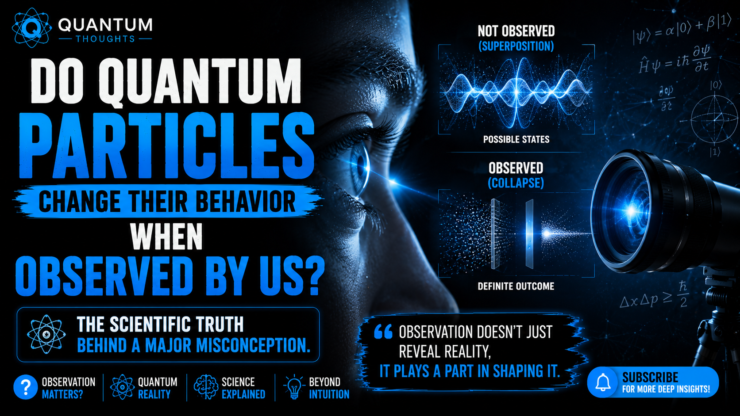
“The greatest mystery in quantum physics is not the behavour of particles, but our misinterpretaion of it”
If you watch social media, youtube or spirtual videos, you have likely heard claims like these :
These claims sound very complling. But are they true?
Short answer is : No.
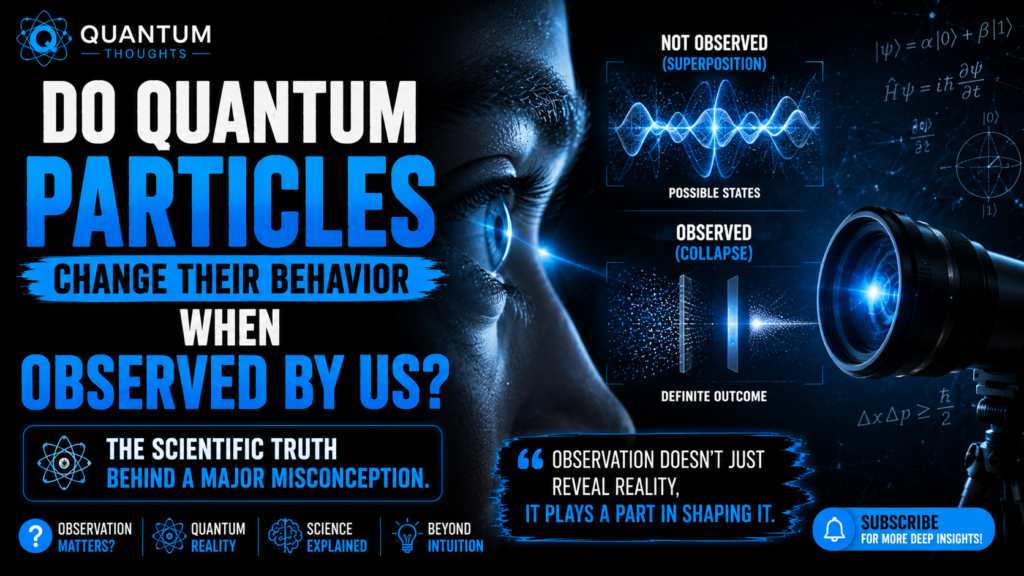
According to modern physics, particals in double split experiment do not change their behavior because of human consiouseness or the fact that someone is watching them. They change because the instrument used to measure them physically interact with them.
Let us understand this conception in simple terms.
What is the double-split experiment ?
Imagine there is a wall infront of you.
There are two very small splits in the wall.
Behind it, there is screen.
Now, we send electrons and photons towards these two splits.
If both splits are open and we do not attempt to measure with split the particle passed through, an interface pattern forms on the screen.
This behavour resembles that of a wave.
However, When we try to determine which split the particle passed though, the interfearence patern disappears.
It then behaves like an ordinary particle.
This is where the biggest misconception began.
What do people believe?
Many People believe :
As soon as someone observes a particle, the particle realizes it is being watched.
From this , they conclude :
However, none of these claims follow directly from the double-split experiment.
What is the true meaning of the word “Observe”
The entire misunderstaning here stems from a single word.
Observe.
In everyday language, it means :
To see with one’s eyes.
However, in quantum physics, the meaning of “Observe” is different.
Here “Observe” means :
Engaging in physical interaction with a particale to obtain information about it.
A human eye is not required for this.
What is particle “Observed”?
Scientists do not view electron with naked eye.
This is because the electron is very small.
To detact it, scientists typically use photons or other detactor.
When photon collides with electron, the electron state may change.
We measure this change.
Thus, the particles’s behavour changes because :
A physical interaction has occured with it.
Not because a human is looking at it.
A camera alone sufficient ?
Imagine placing a CCTV camera in a room.
The camera records the footage.
However, no human watches that video for a whole month.
Would the result of the quantum experience change ?
Yes.
Because the information has already been recorded.
It may no difference whether a human has watched the video or not.
This demonstrates that human consciouseness is not required.
What if no one looks?
Suppose a computer detector records the data.
Then, the hard disk crashes.
No scientist ever seen the data.
Yet, the result will still remain altered.
Because the measurement had already taken place.
What does detactor do ?
A detector merely gathers information.
It does not think.
It possesses no consciouseness.
It has no feelings.
It does not even know what is measuring.
Yet, the quantum result changes.
This is crucial evidence that consciousness is not responsible.
An Example of involving a photon
Imagine a dark room.
You want to find a small ball there.
You switch on the torch.
The light from the torch falls on the ball.
The light strikes it.
Now you can see the ball.
However, the impact of the light might slightly after ball’s position.
The same thing happens in quantum physics.
A photon collides with an electron.
This collision affects its quantum state.
Heisenberg Uncertainty Principle
This principle is also often explained incorrectly.
It does not mean that :
“A particle gests spooked when a human observes it.”
It states that it is fundamentally impossible to measure certain physical quantities simultaneously with perfect precision.
This is a consequence of quantum nature.
Not of consciousness.
Wave function collapse
In quantum mechanics, it is often said that wave function collapse occurs.
Many people believe that :
“Human consciouseness causes wave function collapse.”
However, this idea is not a conclusion of mainstream physics.
It has merely been one historical idea among various interpretations.
The human mind is not considered necessary for modern experiments.
Why did the misconception spread on social media ?
Because :
“Consciousness creates reality.”
This statement sounds very capitivating.
It evokes a sense of wonder in people.
However, in an attempt to simplify the complex subject of quantum physics, people often misrepresent it.
A scientific term “Observation” is interpreted accourding to its everyday meaning.
This is where the entire misconception arises.
Quantum particles do not change because they are watched; they change because every measurement is a physical interaction.
Ravi Dangariya(Rick Patel)








Add comment