

 Ravi Dangariya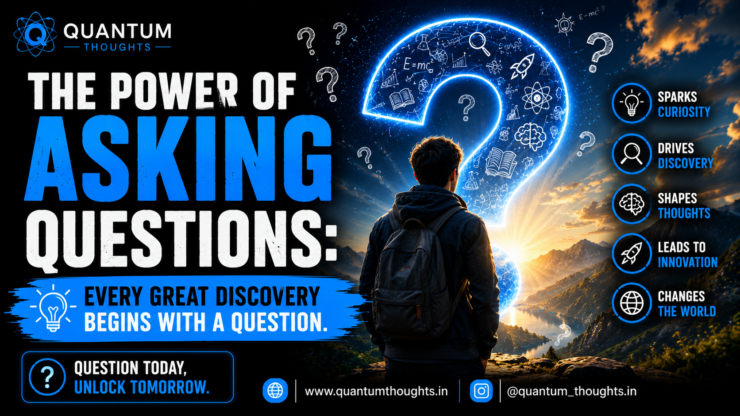
“The quality of your future depends on the quality of the questions you ask today.”
We are curious by nature by birth. Just look at any child; they ask questions all day long “Why is the sky blue?”, “If bird can fly, why can’t we?”, “Where does rain come from?” From child, everything is new, and every question exands their understanding a little further.
However, as we grow older, our questions tend to diminish. Society often teaches us to memorize answers rather than ask questions.
Consequently, we accept many things without ever considering whether they are actually true.
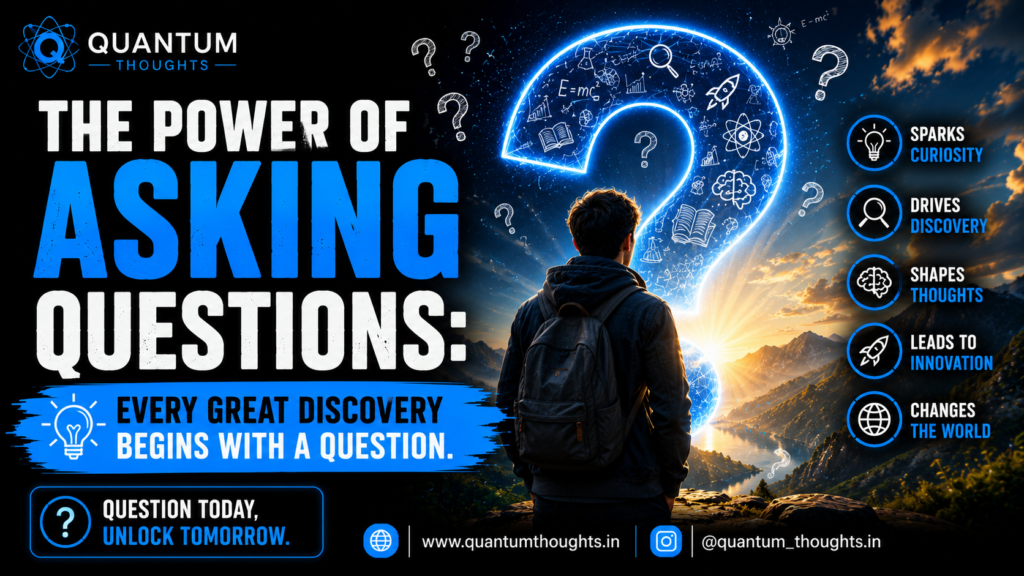
In fact, humity’s greatest process has stemmed not from answers, but from questions. Every great discovery, every scientific revolution, and every philosophical idea begun with a question.
Every discovery began with a question.
Imagine, if no one had ever asked, “Is the earth truly the center of the universe ?” we all might still hold that same belief today.
If Issac Newton hadn’t asked, “Why do objects always fall downwards?”, it might have taken much longer to understand the laws of gravity.
If scientists has not asked, “Is ligth merely a wave, or does it also possess particle like propertiles?”, then a revolutionary field like Quantum Physics might not even exist today.
Each of these discoveries was born a simple yet powerful question.
Questions teach us to think.
The greatest benefit of questions is that they compel us to think.
When we ask a question, our mind does not look for a ready-made answer; instead, it begins to seek new ideas, new evidence, and new perspectives.
The right questions are often simple, yet their answers can be profound.
For Example :
What is the reason for what I believe ?
Are my thoughts my own, or have I been taught them by society?
Do I rely on evidence or merely on beliefs?
Such questions make our thiniking more mature.
Questions and superstition
Superstition arises when the asking of quesions ceases.
If someon says, “That is simply how it is; do not ask questions,” the process of thinking comes to a halt.
Asking a question does not mean opposion something; it means trying to understand.
Science, too, is founded on questions. Before accepting any claims as true, evidence is sought. If new evidence emerges, there is no hesitation in changing old ideas.
This is the greatest strength of science.
The most important questions are those about oneself.
We ask many questions about the world, yet we often ask few questions about ourselves.
Who am I, really ?
Why do I get angry?
Are the decisions I make influenced by emotions or by logics?
Can I view my thoughts objectively?
Such questions lead to self-awareness.
Many people spend their entire lives trying to understand the external world but fail to make time to understand their inner world.
Questions and Metacognition
Metacognition means the ability to think about one’s own thoughts.
It, too, begins with questions.
When we ask ourselves :
Why am I thinking this way?
Is this thought based on facts or merely ana assumption?
Am I falling prey to any bias?
At such times, we do not merely think; we also observe our own thoughts.
This ability makes a person more discerning and aware.
Not all questions have immediate answers
In today’s world, we have become accustomed to getting an immediate answer to every question.
You open the internet, search, and find the information within seconds.
However, there are some questions in life whose answers are found not through reading, but through experience.
Answers to questions like “What is happienss ?”, “What is the meaning of life?”, and “What do I truly want?” are not readily available in any book or website.
Sometimes, a questions stays with you for years and gradully transforms your perspective.
How the courage to ask questions.
Many people are afraid to ask questions. They worry that others might perceive them as ignorant.
In reality, however, it is the person who does not ask questions who misses out on the greatest opportunity to learn.
Every scientist, philosopher, and inventor was once an ordinary person who dared to ask a quesion.
Asking a question is not a sign of weakness; it is a mark of intelligence and curiosity.
Life-Changing Questions
Everyone should ask themeselves these questions at some point :
What is the strongest evidence for what I believe?
Am I Willing to change my beliefe if I am wrong?
Am I open to accepting new information?
Am I seeking the answer, or am I merely trying to prove my belief right?
These questions make our thiniking more objective and open-minded.
Questions are the bridge between what we believe and what we can discover.
Ravi Dangariya(Rick Patel)







Add comment