

 Ravi Dangariya
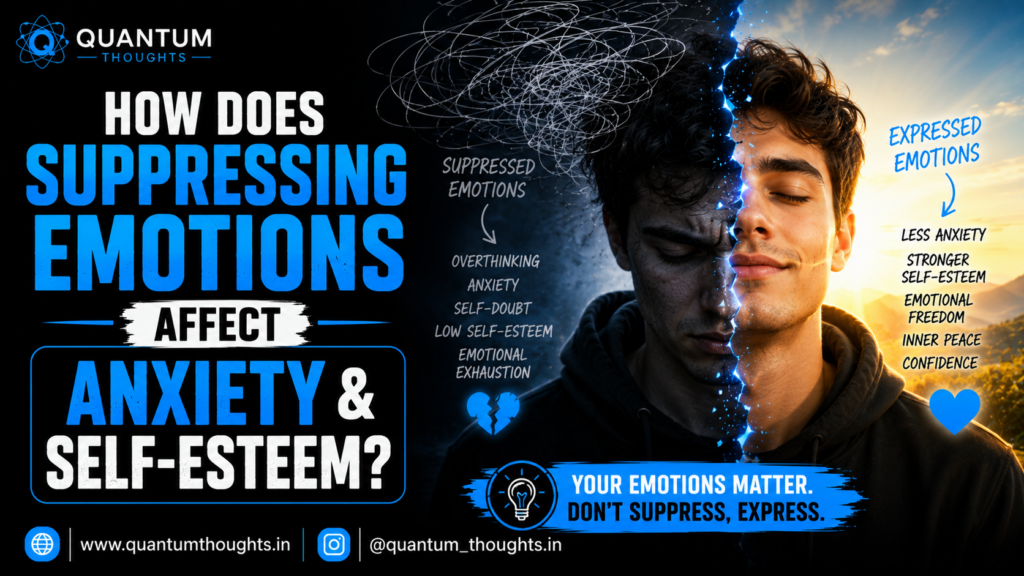
The emotions we refuse to feel often become the thoughts we cannot escape.
Many of us have heard that same things since childhood “Don’t cry,” “Don’t get angry,” “Strong people don’t show their emotions.” Gradually, we come to believe the expressing emotions is a sign of weakness and that suppressing them is a sign of maturity.
But is that really the case ?
Modern psychology suggests that constantly trying to suppress emotions without understanding or accepting them can have a serious impact on our mental health. It particularly affects anxiety and self-esteem.
In this article, we will try to understand what happens in our minds when we suppress emotions and how it affects our lives.
What does it mean to suppress emotions?
Suppressing emotions does not mean that a person does not feel sadness or anger. It means that, instead of expresssing the emotions arising within, the person attempts to hide or ignore them.
For Example,
- Saying “I am fine” even when feeling sad.
- Smiling constantly despite feeling angry.
- Refusing to acknowledge one’s feeling even when afraid.
- Suppressing one’s emotions to avoid hurting others.
This may seem like an easy path in the short term, but one may have to pay a price for it in the long term.
Why are emotions important ?
Emotions are the language of our mind. Just as physical pain signals a problem, emotions provide information about our inner experiences.
Fear warns us of danger.
Sadness helps us to accept loss.
Anger indicates that a boundary of ours may have been violated.
If we repeatedly ignore these signals, the problem does not go away; it simply accumulates within us.
Why does suppressing emotions increase anxiety?
Many people believe that suppressing their emotions will help them remain calmer.
However, the result is often opposite.
When we suppress an emotion, the brain does not fully let go of it; instead, it repeatedly returns to that same emotion or thought.
This constant internal conflict can increase mental stress. Over time, a person may experience persistent restlessness, overthinking, sleep disturbances, or constant feeling that something is about to go wrong.
So, anxiety often increases not only due to external circumstances but also because of suppressed emotions.
Impact on Self-Esteem
When a person repeatedly ignores their own feelings, they gradually begin to neglect themselves as well.
Thoughts like these may arise in their mind :
“My feelings do not matter.”
“I must always keep others happy.”
“If I show my feelings, people will perceive me as weak.”
Such thoughts gradually erode self-esteem.
Healthy self-esteem is not merely about self-confidence; it also means respecting one’s own feelings and needs.
Should every emotion be expressed?
No.
It is not neccessary to express every emotion imediately.
If you are very angry, reacting instantly might not be appropriate.
However, that does not mean you should bottle up that anger inside you for months.
The best approach is to first acknowledge the emotion, and then express it appropriately with a calm mind or reflect upon it.
What are the benefits of accepting one’s emotions?
Research suggests that people who try to accept and understand their emotions often experience greater psychological flexibility.
This may :
Experience less anxiety.
Have healthier relationships.
See an improvement in self-esteem.
Gain greater clarity in decision-making.
This is because they do not fight against their inner world but instead try to understand it.
How can one start understanding their own emotions?
Take some time each day to ask yourself :
- What am I feeling right now?
- What could be the reason for this feeling?
- Am I accepting it or suppressing it?
- If a friend were experiencing the same feeling, what would I say to them?
Such simple questions can help us understand our inner state.
Sometimes anxiety is not created by what we feel, but by everything we refuse to feel.
Ravi Dangariya(Rick Patel)








Add comment