

 Ravi Dangariya
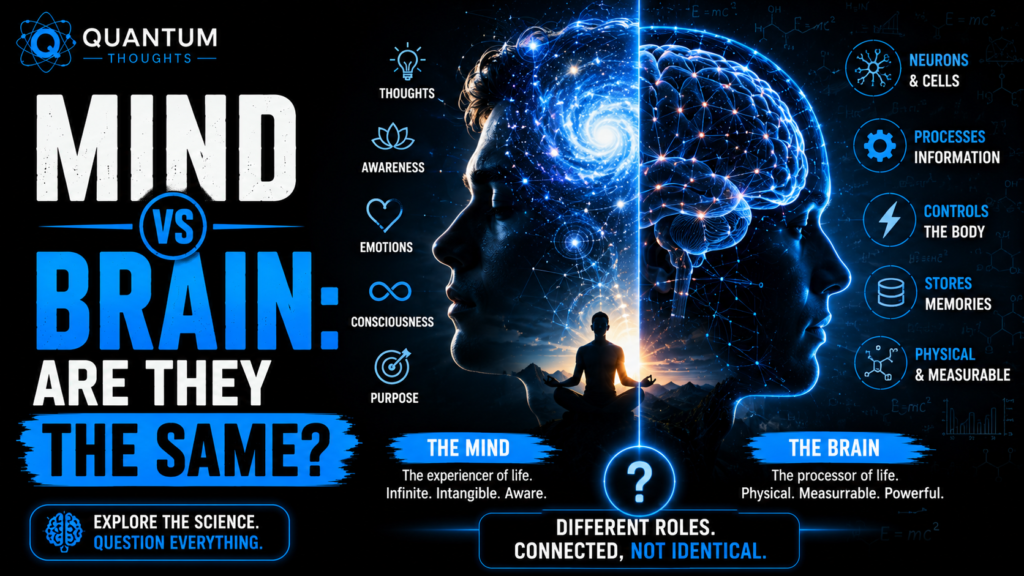
In our daily lives, we often say thing like : “My Mind isn’t calm today ,” “”My brain isn’t working,” “My mind says to this, but my brain say no.” we use this word “mind” and “brain”, but we have ever wordered if they are the same thing ?
Many people consider then mind and the brain to the same thing, as both are linked to thinking, decision-making, memory, and behavour. However, when we examine this question from the perspectives of science, psychology , and philosophy, we realize that the subject is not quite so simple.
The brain is physically organ, whereas the mind can be directly seen or touched. Yet,we experience thoughts, dream, love, feel, fear, and make decisions every day. So, where does all this take place? Is it merely the activity of the brain, or is there a disctinct prcess know as the mind ?
In this article, we will try to understand the relationship between the mind and the brain, the differences between the two, and how modern science views this question.
What is the brain ?
The brain is most complex organ in our body. It weighs, on average, between 1.3 to 1.4 kilograms and contains approximately 86 billion nerve cells(neurons).
This neurons communicate with each other through electrical and chemical signals. It is because of this communication that we can see, hear, walk, understand language, remember things, and learn new things.
If an injury occurs to any part of the brain, a person’s memory, language, decision-making ability, or even personality can undergo changes. This makes it clear that the brain is crucial for every mental funciton.
What is the mind ?
Defining the mind is far more difficult that defining the brain.
You can not locate the mind as a specific part of the body. During surgery , a doctor can see the brain, but not the mind.
So, what excactly is the mind ?
Simply put, the mind is the term that encompasses the entire process of thoughts, emotions, imagination, memories, desires, attention, and experiences.
When you feel joy upon seeing a beautiful view, sadness when recalling a painful event, or think about the future, we say that mind is at work.
Does the mind orginate from the brain ?
This is crucial question.
Accourding to the modern neuroscience, every mentan experience we have is linked to brain activity.
For Example :
- Specific area of the brain becomes more active when a person is afraid.
- New connections form between neurons when we learn something new.
- Thinking paterns can change due to sleep, medication, or injury.
Therefore, many scientists believe that the mind is an “emergent property” arising from the brain’s complex processes.
However, science does not yet have a complete answer as to how subjective experiences such as the feeling of sadeness, joy, or the perception of color arise from the brain’s physical activity.
What does philosophy say ?
Philosophers have been asking this question for thousands of years.
One school of thought holds that the mind and body are saperate. This perspective is known as dualism.
Another perspective maintains that the mind and the brain are not saperate; the mind is a function of the brain. This is known as physicalism.
Today, Most neuroscientists lean towards physicalism, yet the debate regarding consciousness and subjective experience continues.
A simple example :
Imagine you are a computer.
Computer hardware refers to its chips ,momory and wires.
Software refers to the processes that enable the computer to function.
This analogy is not perfect, but it is useful for understanding the concept.
Many people say that the brain is like hardware and the mind is like software.
Software can not run without hardware, and hardware is not useful without software.
Similarly, the mind and the brain are closely interconnected.
Where do thoughts originate ?
Thousands of thoughts cross our minds everyday.
But Where do they come from ?
According to science, thoughts are the result of complex neural activity occuring between various regions of the brain.
However, no specific “thought center” has been found.
Thoughts do not originate in a single location; rather, multiple areas work together to create ther process of thninking.
The role of the brain in Emotions :
Emotions such as love,fear, anger, joy and sadness are linked to the brain.
Various part of the brain and chemicals influence emotions.
However, this does not mean that emotions are merely chemicals.
Chemicals are the part of the underlying processes, but the subjective experience remains one of the greatest mystries of consciousness.
Does the mind change if the brain changes?
Yes, this is observed in many cases.
Brain injuries, strokes, other neurological disorders can bring about changes in a person’s memory, behavour, and personality.
This highlights the close relationship between the brain and the mind.
However, the question remains : does this relationship signify complete identify or merely a strong connection ?
Science is still seeking the answer to this.
Where does consciousness come from ?
This is one of the most difficult questions.
Billions of neurons function within the brain.
But how does an awareness like “I feel” emerge from them ?
Many scientists refer to this question as the “Hard Problem of Consciousness.”
To date, no universally accepted answer has been found.
The brain may create thoughts, but the mind is where they become experience.
-Ravi Dangariya (Rick Patel)







Add comment